The Castle of Midilli (Mytilene) from Antiquity to the Ottoman Period and the Euripos Waterway
Introduction
Today, visitors arriving in Midilli (Lesvos) can reach the city center and the castle within just a few minutes after disembarking from the ferry. At first glance, Midilli Castle appears to be a ordinary peninsula castle attached to the coast. However, history, archaeology, and old maps tell a very different story.
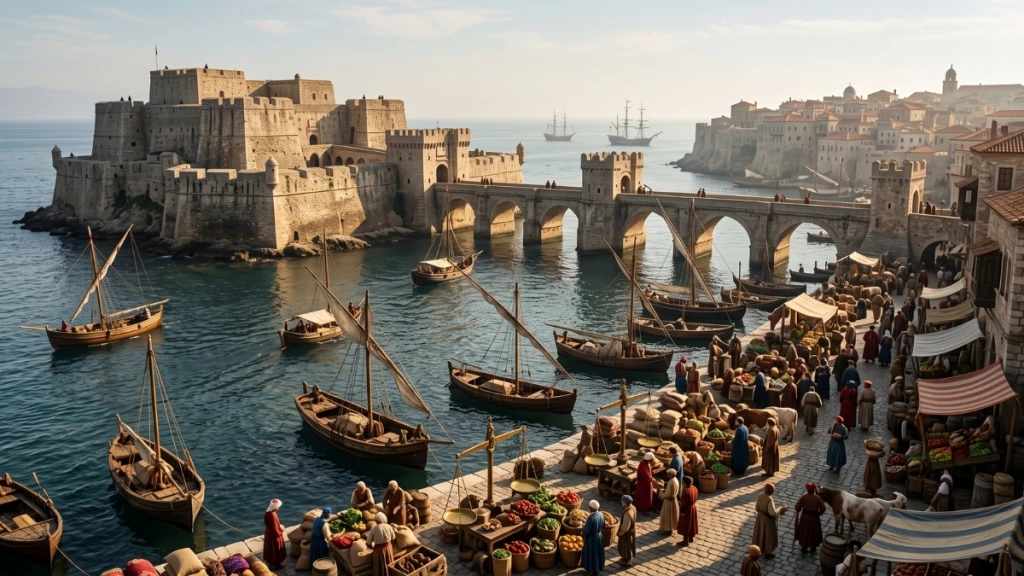
For nearly two thousand years, the area where Midilli Castle stands was in fact a true “island-castle.” Between the castle and the city center there was a sea channel connecting the northern and southern harbors. In Greek sources, this channel is referred to as “Εύριπος – Euripos.”
Beneath the streets people walk on today and the areas where they shop, seawater once flowed, and ships passed through the castle to sail between the two harbors.
Geographical Structure
The city of Midilli was naturally established between two harbors.
Northern Harbor
- It was more sheltered and had deeper water.
- It was the center of commercial activity.
- It was used by small and medium-sized merchant ships.
- It corresponds to today’s Epano Skala area.
Southern Harbor
- In antiquity, it had a military harbor function.
- It was one of the areas where trireme-type warships were stationed.
- It later retained its strategic importance during the Ottoman period as well.
The natural sea passage connecting these two harbors:
EURIPOS CHANNEL
was known as.
Dimensions of the Euripos Channel
Various Greek archaeological studies and academic research indicate that:
- Length: approximately 650–700 meters
- Width: approximately 25–35 meters
- Depth: not known precisely, but suitable for the passage of small and medium-sized ships
This shows that it was.
Could Three Ships Pass Side by Side?
In local Midilli traditions and some tourist sources:
“Three ships could pass side by side.”
is used.
Although this exact sentence does not appear in primary sources:
Ancient warships:
- Width: approximately 5–6 meters
Small merchant ships:
- Width: approximately 4–5 meters
In a waterway around 30 meters wide:
- the passage of 3 ships side by side,
- and even maneuvering by 4 small ships in some sections,
was technically possible.
Therefore, this account is not entirely a legend and is compatible with the dimensions of the channel.
Midilli Castle Was Actually an Island
Thanks to Euripos, the castle area was:
- sea to the north,
- sea to the south,
- the Aegean Sea to the west,
- and the Euripos Channel to the east
surrounded by.
For this reason, today’s peninsula appearance is misleading.
Throughout the Middle Ages, the castle was a true ISLAND-CASTLE.
This provided an extraordinary advantage in terms of defense.
The enemy:
- could not approach by land,
- could not easily bring heavy siege engines,
- and could attack only from specific passage points.
Bridges
Archaeological studies and old engravings show that there were bridges over the Euripos.
These bridges had structures made of:
- wood,
- stone piers,
- and could be lifted when necessary
.
Some researchers also argue that there were marble bridges during the Roman period.
In old engravings:
- bridges crossing the water channel,
- towers protecting the bridge entrances,
- defensive gates opening toward the sea
are clearly visible.
Ancient Midilli
Midilli was one of the most important cities of Ancient Greece.
In particular:
- Sappho
- Pittakos
- Theophrastos
famous names lived here.
In the 7th–6th centuries BCE, Midilli became:
- a powerful maritime city,
- a commercial center,
- a cultural capital
.
The Euripos Channel was also an important part of this maritime system.
Roman Period
During the Roman period, Midilli:
- gained privileged city status,
- its harbors expanded,
- trade developed.
Thanks to the channel connecting the two harbors:
- ships did not have to sail around the city,
- trade was conducted more quickly.
It is thought that on the shores of the channel during the Roman period there were:
- quays,
- warehouses,
- shipyard areas
.
Byzantine Period
During the Byzantine period, the castle gained even greater importance.
Due to Arab raids and pirate attacks:
- the walls were raised,
- towers were built,
- passages were brought under control.
Euripos was now not only a trade route but also a defensive element.
The entrances of the channel could be closed with chains when necessary.
The Year 1355 and the Gattilusio Period
The turning point in Midilli’s history:
is the year 1355.
Byzantine Emperor John V Palaiologos:
gave Lesvos to the Genoese noble Francesco Gattilusio,
in return for his marriage to his sister Maria.
Thus began the Gattilusio period, which would last from:
1355–1462
.
What the Gattilusio Family Did
The Gattilusio family:
- expanded the castle,
- built new walls,
- strengthened the towers,
- reorganized the sea gates,
- developed the harbors.
Midilli:
became one of the most important bases of the Genoese trade network in the Aegean.
Istanbul,
Chios,
Foça,
Midilli
all operated within the same trade chain.
Why Was It So Important?
Because Midilli:
was only about 10 kilometers from the Anatolian coast.
From the coast of Dikili, the island can be clearly seen.
For this reason, it had a unique position in terms of:
- trade,
- customs,
- military surveillance,
- sea control
.
The Ottoman Conquest
Mehmed the Conqueror:
conquered Midilli in 1462.
The Ottomans:
- restored the castle,
- adapted it for artillery systems,
- built new walls,
- constructed barracks.
Midilli in Ottoman Documents
Tax registers and Ottoman archives show that Midilli was:
- a sancak center,
- an important garrison,
- one of the main points of Aegean maritime security
.
During the Ottoman period, the castle saw the construction of:
- mosques,
- baths,
- warehouses,
- madrasas,
- fountains,
- military structures
.
Midilli played an important role in securing:
the Gulf of Izmir,
the Dardanelles Strait,
and the western Anatolian coasts.
Why Did the Channel Disappear?
Over the centuries:
- earthquakes,
- alluvial sediment transport,
- natural filling,
- man-made infill
caused the Euripos to become progressively shallower.
- century, the infilling process began.
By the 15th–16th centuries, the channel had largely lost its function.
Later it was completely filled in.
Today:
the castle no longer has its island character.
Where the Channel Ran Today
Research shows that the old Euripos was approximately located along the line of:
Epano Skala
↓
Ermou Street
↓
Koumidia
↓
Southern Harbor
.
In other words:
Today, the areas in Midilli where we walk, shop, and sit in cafés were once beneath the sea.
The Most Striking Fact for Today’s Visitor
A visitor coming to Midilli from Dikili:
unwittingly
is walking above a water channel through which ships passed about two thousand years ago.
Today’s Midilli Castle:
was once in fact:
- surrounded by water,
- connected by bridges,
- with ships passing through it,
- and controlling the two harbors,
a true ISLAND-CASTLE.
Perhaps this is one of the greatest secrets of the Aegean.
Because most people who come to Midilli today leave the island without ever knowing that there was once a sea flowing through the city center and that ships sailed through the castle between the northern and southern harbors.