It would be incomplete to describe Lesvos solely through its beautiful beaches, stone villages, and Aegean cuisine. Because Lesvos is a multifaceted island, with the millions-of-years-old geological history of the land beneath your feet, its literature stretching from antiquity to the present day, its distinctive gastronomy, and one of Europe's most important wetlands.
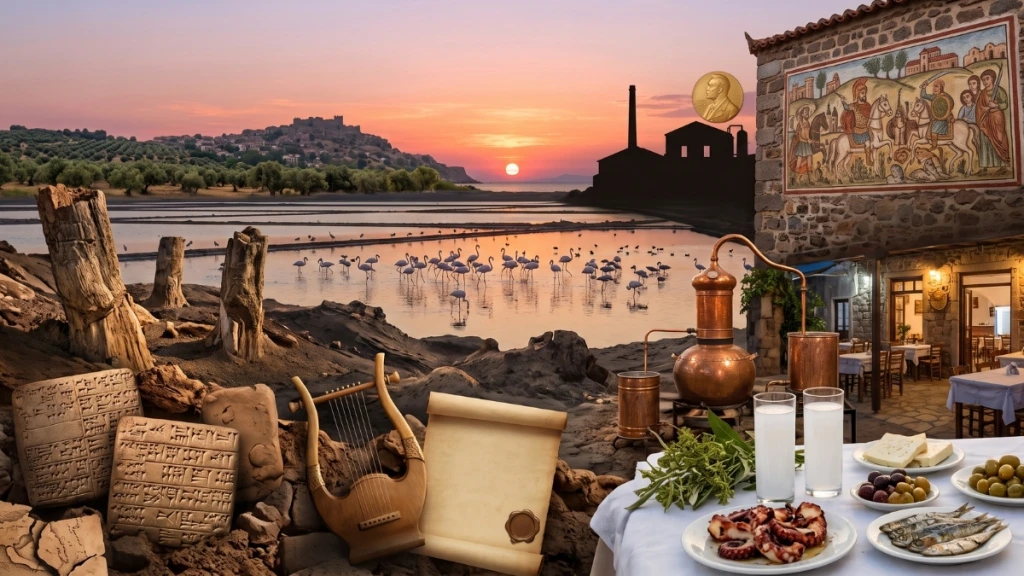
Sometimes you encounter the origin of a name in Hittite tablets, sometimes the trunk of a tree that lived 18 million years ago in Sigri, sometimes the scent of anise rising from a copper still in Plomari, and sometimes a flamingo taking a break in Kalloni Gulf during a migration journey spanning thousands of kilometers.
Six topics are particularly important for understanding Lesvos's story.
1. Following the Name of an Island: Where Does the Name Lesvos Come From?
Perhaps the most appropriate question to begin an island's story with is:
Why is it called Lesvos?
The name of the island known as Midilli in Turkish and Lesvos in Greek opens the door to a fascinating story that actually takes us back thousands of years.
According to ancient Greek mythology, one of the island's first rulers is described as Makaras or Macareus. In the mythological account, Makaras is the son of Helios, the Sun God, and during his reign the island was known for a time as Makaria.
Then a young hero from Thessaly enters the story: Lesvos.
According to legend, Lesvos marries Methymna, the daughter of Makaras. Over time, the hero's name becomes identified with the entire island, and the island begins to be called Lesvos. The ancient name of today's Molyvos, Methymna, also bears traces of the same mythological family.
But the much more exciting part of the story begins before mythology.
Was there a “Lazpa” before Lesvos?
A place called “Lazpa” is mentioned in Hittite cuneiform documents dating to approximately the 14th–13th centuries BCE.
Modern Hittite scholarship generally accepts that Lazpa was most likely the Island of Lesvos. In the University of Mainz's database of Hittite place names, “Lazpa” is recorded in three different Hittite texts. Studies published in Oxford also examine the connection between Lazpa in Hittite documents and Lesvos.
This detail is very important.
Because it means we can trace Lesvos's written history hundreds of years further back than the classical Greek world, as far as the Late Bronze Age.
One of the Hittite documents mentions the gods of Lazpa. Another document mentions Lazpa during political struggles in the region. These records show how strong the island's relations with the Anatolian world already were approximately 3,300 years ago.
For this reason, viewing Lesvos solely as a “Greek island” is historically incomplete.
Because of its geographical position, the island has been one of the meeting points of Anatolia and the Aegean world for thousands of years.
When you look at Lesvos from the shores of Ayvalık today, the proximity you see is not merely geographical. There has also been a relationship between the two shores for thousands of years in terms of language, trade, beliefs, agriculture, seafaring, and culture.
The claim in the Instagram post that “the word Lazzas means green or fertile” should be used more cautiously. The academic basis for the Lazpa–Lesvos connection is strong; however, it is not sufficiently well established today to say definitively that the word means “fertile” or “green.”
Perhaps the beauty of the name Lesvos lies precisely here:
While mythology tells us the name of a hero, archaeology and Hittite tablets suggest that a much older Aegean–Anatolian past may lie behind the same name.
In a way, even the name Lesvos resembles the island itself:
layer upon layer, ancient, and still not completely deciphered.
2. Much Larger Than It Looks on the Map: Lesvos, Greece's Third-Largest Island
Many visitors coming to Lesvos for the first time make the same mistake:
They think the island is small.
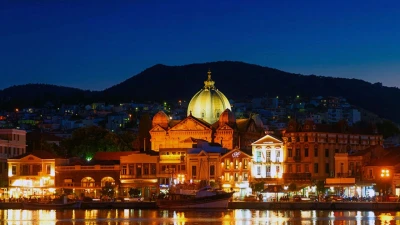
When you look at the map, you see a classic Aegean island. When you disembark from the ferry at Mytilene Port, the city center also appears compact.
But as soon as you begin traveling north, west, or south by car, your perception quickly changes.
Because with an area of approximately 1,633 km², Lesvos is Greece's third-largest island, after Crete and Evia. Greece's official tourism website also describes it as one of the largest islands in the Mediterranean.
Moreover, it is not only the island's area that makes Lesvos large.
Its coastline extends for approximately 459 kilometers.
You understand what this figure means better while traveling around Lesvos.
You might wake up one morning among the stone houses of Molyvos, pass through Kalloni's wetlands in the afternoon, then reach the volcanic landscape of Eresos and watch the sunset in Sigri before an entirely different view.
And you are still on the same island.
An island shaped by two large gulfs
One of the most striking features of Lesvos's geography is its two large natural gulfs that extend deep into the land:
Kalloni Gulf and Gera Gulf.
While these two gulfs create the island's characteristic shape on the map, they also shape Lesvos's climate, fishing, settlements, and wildlife.
Kalloni Gulf covers approximately 110 km² and functions almost like a large lagoon, with its shallow structure connected to the Aegean by a narrow strait.
Gera Gulf in the east is surrounded by olive groves, small coastal settlements, and wetlands.
As a result, there is no single island landscape in Lesvos.
In the north, stone villages and mountainous shores stand out around Molyvos, Petra, and Eftalou.
In the east, Mytilene and Thermi offer a livelier face overlooking the Anatolian coast.
In the south, Plomari and Agios Isidoros have acquired a distinct identity through their maritime and ouzo culture.
At the center of the island, Kalloni is completely different, with its wetlands and broad plains.
As you continue westward, the olive groves and forests gradually give way to a barer, harsher, and more volcanic landscape.
And eventually, around Eresos and Sigri, you feel almost as if you have entered another island.
This change has a geological explanation. Intense volcanic activity took place in western Lesvos approximately 21.5–16.5 million years ago, laying the foundations of today's volcanic landscape.
That is why “exploring the island” in the conventional sense is not a few-hour activity in Lesvos.
Here, the changing geography is as much a part of the journey as the distances.
In a sense, Lesvos is not one large island;
it is several different Aegean geographies fitting into the same landmass.
Perhaps that is the most beautiful part of discovering it.
Seeing Mytilene does not mean you have seen Lesvos.
Nor does seeing Molyvos.
As you see Plomari, Kalloni, Agiasos, Eresos, and Sigri, you realize that the island reveals another face to you each time.
3. A Time Machine: Lesvos's Petrified Forest
Lesvos begins to change as you travel toward Sigri.
The millions of olive trees in the east gradually become fewer. Green gives way to shades of yellow, brown, and red. The hills become bare. The rocks become more prominent.
For someone visiting for the first time, the landscape is surprising.
Because this is not the Lesvos you saw a few hours earlier.
In fact, this is precisely where one of the island's greatest stories begins.
Approximately 18.5–20 million years ago.
Where the dry volcanic terrain around Sigri, Antissa, and Eresos can be seen today, there was once a dense, subtropical forest.
Giant trees resembling sequoias, pine species, cypress-like conifers, and plants bearing various fruits grew here.
Then the geological balance changed.
Very powerful volcanic activity began in the northeastern Aegean.
Ash, lava, and hot volcanic materials from the volcanoes largely covered the forest. The trees were left in an airless environment. Later, silica-rich hydrothermal fluids entered the plant tissues, replacing the organic structure with mineral matter over a very long period.
The tree did not disappear.
It turned to stone.
Moreover, some remained where they had fallen, while others remained standing in the positions where they had grown millions of years ago.
UNESCO records state that Lesvos's Petrified Forest preserves an ecosystem that lived approximately 18.5 million years ago. More than 46 plant species and genera have been identified in the area. The fossils include not only trunks, but also root systems, branches, leaves, and fruits.
Some standing fossil trunks exceed 7 meters in height, while their diameters can reach approximately 3 meters.
For this reason, what you see in Sigri is not merely a few petrified trees.
Before you lies an entire fossil ecosystem.
A 15,000-hectare natural archive
The protected Petrified Forest area covers approximately 15,000 hectares.
The fossils are not found only on land.
Fossilized trees can also be found in the marine area around Nisiopi. Today, some sections of this geological heritage at sea can be seen through special boat tours.
Greece declared the Petrified Forest a Protected Natural Monument in 1985.
The area is also protected within the Natura 2000 network.
There is an important detail here that is often confused:
Lesvos's Petrified Forest is not currently on the UNESCO World Heritage List; it is on the World Heritage Tentative List.
In contrast, the entirety of Lesvos holds UNESCO Global Geopark status.
The Natural History Museum of the Lesvos Petrified Forest in Sigri is one of the island's most important stops for understanding this extraordinary geological story.
After leaving the museum, the meaning of the stones begins to change as you look at the surrounding fossil sites.
You are no longer looking at a rock.
You are looking at the cellular structure of a tree that was once alive.
A tree over which the wind passed, on whose branches rain fell, and around which animals that no longer exist today may once have roamed…
Then a volcano erupted and time stopped.
Perhaps this is the most impressive aspect of Lesvos's Petrified Forest:
Being able to see a day from 20 million years ago even today.
4. From Plomari to the World: Why Is Lesvos the Capital of Ouzo?
If you walk along the waterfront in Plomari around noon, after a while you begin to see the same scene on the tables.
Small plates in the middle…
Octopus, sardines, cheese, olives, shellfish…
And beside them, ouzo in long, slender glasses that slowly turns white when mixed with water.
Here, ouzo is not merely a drink.
It is a table ritual.
And in Lesvos, this ritual has a strong production tradition of approximately two centuries.
There are approximately 17 ouzo producers on the island today, and according to Visit Lesvos data, these producers account for at least half of Greece's total ouzo production. Several of the largest ouzo brands known in Greece and international markets are also headquartered in Lesvos.
For this reason, the expression “Capital of Ouzo” used for Plomari is not merely a tourist slogan.
It has a genuine production culture behind it.
Why Plomari?
- In the 18th century, Plomari was not merely a beautiful seaside town.
It was a bustling center of trade and production.
Olive-oil mills, soap workshops, shipyards, and small distilleries shaped the town's economic life. Local ouzo production initially took place in small distilling workshops known as “rakaria.”
- By the end of the 19th century, production began to grow, develop brands, and turn toward exports.
At the heart of ouzo was the copper still.
In traditional production, various aromatic plants, especially anise, are included in the distillation process. Recipes that vary from producer to producer, the proportions of the plants used, the still system, and the distillation technique create different characters.
Anise grown in the Lisvori region is particularly important in Plomari ouzo.
According to Greece's official technical file, the aromatic plants used in the production of “Ouzo of Plomari” specifically include anise of Lesvos origin, particularly Lisvori anise — Pimpinella anisum —. The production and bottling processes of a product bearing the Plomari geographical indication must also take place within the designated geographical area of Plomari.
More importantly:
“Ouzo of Plomari” and “Ouzo of Mitilene” are among the geographical indications recognized at European Union level.
So here we are no longer talking merely about a drink, but about the production culture of a particular region.
Why does ouzo turn white when water is added?
Ouzo's most recognizable appearance also comes from its chemistry.
Anethole, one of the important components of the aromatic essential oils in anise, dissolves in a high-alcohol environment. When water is added to ouzo, the alcohol content decreases and anethole disperses through the liquid in the form of tiny oil droplets.
The result:
Within a few seconds, clear ouzo transforms into that characteristic milky-white appearance.
But for the people of Lesvos, the real point of the ouzo story is not inside the glass, but around it.
Ouzo is not considered something to be consumed in a hurry.
You sit down at a table.
Meze arrives.
You talk.
You look out at the sea.
Another plate arrives.
The conversation goes on.
That is why understanding the ouzo experience in Plomari is not merely about visiting a distillery.
It is actually about understanding how to live a little more slowly in the Aegean.
And perhaps that is why ouzo and the character of Lesvos resemble each other so closely:
Both want to be discovered, rather than consumed quickly,
slowly, little by little.
5. From Sappho to Elytis: Why Did This Island Produce So Many Artists and Thinkers?
You cannot measure an island's size only in square kilometers.
There are places that are geographically small but have left an astonishingly large mark on world cultural history.
Lesvos is exactly such a place.
Approximately 2,600 years ago, the verses of a woman poet who lived on this island were being read at universities around the world.
Her name:
Sappho.
Sappho, regarded as one of the greatest lyric poets of the ancient world, was certainly from Lesvos; local tradition and official Lesvos sources identify Eresos as her birthplace.
In the 7th–6th centuries BCE, when Sappho lived, poetry was not written to be read silently as it is today.
Poetry was sung together with music.
Love, longing, beauty, separation, and human emotions were at the center of her verses.
Despite the passage of approximately 2,600 years and the loss of most of her works, the surviving fragments have made Sappho one of the best-known names in world literature.
When you look out at the sea in Skala Eresos today, you are not merely looking at a beautiful beach.
You are looking at one of the oldest geographies of the Western lyric poetry tradition.
One of the pioneers of science from the same town
Eresos's story does not end with Sappho.
Approximately three centuries later, another name emerged from the same region:
Theophrastus.
Theophrastus was Aristotle's close student and later the philosopher who became head of the Lyceum in Athens. He was born in Eresos. Because of his work studying plants systematically, he is often regarded in the history of science as one of the founding figures of botany.
Even more interestingly, Aristotle himself is known to have spent some time in Lesvos and to have particularly observed the marine life in Kalloni Gulf.
For this reason, Kalloni is sometimes promoted today as “Aristotle's Lagoon.”
So on the same island there is Sappho, who changed the history of human emotions on one side, and Theophrastus and Aristotle, who sought to understand nature systematically, on the other.
Poetry and science…
Both meet in Lesvos's story.
Theophilos centuries later
More than two thousand years passed.
This time, an extraordinary folk painter was born in the Vareia area just outside the city of Mytilene:
Theophilos Hatzimihail.
Theophilos was not one of the classical painters of the academic art world.
He painted daily life, villagers, cafés, heroes, mythological scenes, Alexander the Great, and figures from Greek history in his own distinctive, naive style.
Today, the Theophilos Museum in Vareia, where he was born and raised, houses an important collection of 86 of the artist's works. The museum was built in 1964, and the collection was donated the following year.
When you look at Theophilos's paintings, you see more than just pictures.
You also see the daily life, villages, clothing, and imagined world of old Lesvos.
And the Lesvos connection reaching the Nobel Prize
Another important name in this cultural chain is Odysseas Elytis.
There is a small but important detail here:
Elytis was not born in Lesvos.
He was born in Heraklion, Crete, in 1911. However, his family originated from Lesvos, and Elytis had a strong cultural and family connection with the island. In his biography, Lesvos is also identified as his “island of origin.”
Elytis received the Nobel Prize in Literature in 1979.
A physical trace of his family's story in Lesvos can still be seen today in the village of Papados in Gera.
The Vranas Olive-Oil Factory founded by his grandfather Nikolaos Vranas in 1887 now serves as a museum. One of the museum's permanent exhibitions is devoted directly to the theme of “Elytis's Lesvos.”
Sappho, Theophrastus, Aristotle, Theophilos, Elytis…
When you put these names side by side, something interesting emerges.
Lesvos's cultural heritage does not belong to a single period.
We are speaking of a chain of thought and art spanning more than 2,600 years.
Perhaps the reason is the island's geography.
Perhaps it is the light of the Aegean.
Perhaps it is its position between Anatolia and the Greek world.
Or perhaps it is the meeting of so many different stories of nature and humanity in one place.
One thing is certain:
Lesvos is not merely an island to be seen.
It is an island that has inspired people for centuries to think, write, and draw.
6. Looking to the Sky in Kalloni: One of Europe's Birdwatching Paradises
In spring, a strange sense of activity begins around Kalloni Gulf while the day is still just dawning.
People wait by the roadside with large cameras, tripods, and binoculars in their hands.
Some have come from Britain, others from the Netherlands, Germany, or the Scandinavian countries.
They can stare at the same wetland for hours.
Because some of the birds they have traveled thousands of kilometers to see are simultaneously undertaking another journey spanning thousands of kilometers.
Lesvos lies directly on one of the major bird migration routes between Europe and Africa.
Moreover, because it is very close to the Anatolian coast, the habitats of species originating in Europe and Asia come close together here.
The result is extraordinary:
Approximately 320 different bird species have been recorded on the island. Some live here, some breed here, some spend the winter here, while others stop briefly in Lesvos only during their long migration journeys.
The center of the story: Kalloni Gulf
One of the most important birdwatching locations is Kalloni Gulf and the wetlands surrounding it.
There is not merely one lake or marsh here.
Salt pans, small river mouths, reed beds, salt marshes, lagoons, pine forests, and olive groves connect to form a large ecological system.
The Kalloni and Polichnitos salt pans, streams such as Tsiknias and Vouvaris, Messa Lagoon, and the wetlands around Skala Kallonis are parts of this system.
The coastal wetlands of Kalloni are also among the special protection areas for birds within Europe's Natura 2000 conservation network.
And one of the most striking visitors to this landscape is undoubtedly:
Flamingos.
Especially when the water is calm, it is possible to see dozens—or, in suitable periods, large numbers—of flamingos feeding in the shallow waters.
But it would be a great injustice to describe Kalloni's birdlife only through flamingos.
Many species can be seen here, including black storks, black-winged stilts, avocets, glossy ibises, ruddy shelducks, various herons, and white storks.
Even more interesting are some eastern species that can be seen because of Lesvos's proximity to Anatolia.
For example, Krüper's nuthatch – Sitta krueperi, has a very limited distribution in Europe and is a special species for Lesvos birdwatchers.
Similarly, species such as cinereous bunting – Emberiza cineracea and pied kingfishers reflect the Eastern Mediterranean character of the island's bird fauna.
This is why British and Northern European birdwatchers are particularly interested in Lesvos.
The busiest period is the spring migration.
As birds that have spent the winter in Africa return north, they reach Europe via the Aegean. Lesvos's wetlands offer them natural stations where they can rest, feed, and prepare to continue their journey.
In autumn, the journey reverses.
Aristotle also looked at these same waters
There is another detail that makes Kalloni's story even more special.
Approximately 2,300 years ago, Aristotle was also studying nature around the gulf where people today stand watching birds through binoculars.
During his stay in Lesvos, Aristotle observed the marine life in and around Kalloni Gulf. His studies of the behavior, anatomy, and ways of life of living creatures later became some of the foundational texts in the history of zoology.
For this reason, the region's being known as “Aristotle's Lagoon” is no coincidence.
Imagine:
Today, a biologist is studying flamingos with a telescope in the same wetland.
2,300 years ago, Aristotle was observing marine life there.
Perhaps this is precisely what makes Lesvos valuable.
Nature here is not merely a beautiful view.
It is a living laboratory that has been observed, studied, and sought to be protected for thousands of years.
As flamingos walk through the shallow water toward sunset in Kalloni, the hills of Lesvos rise behind them.
At that moment, the entire story of the island comes together in a single landscape:
An island between Anatolia and Europe…
A geography millions of years old…
A human history thousands of years old…
And birds much older than all of these, continuing to follow the same route every year.
Lesvos: Much More Than Six Stories
The name Lesvos takes us back to the Hittites' Lazpa.
Its geography makes it Greece's third-largest island.
The petrified trees in Sigri carry the world of 18–20 million years ago into the present.
The copper stills in Plomari keep alive an ouzo culture spanning more than two centuries.
The cultural chain extending from Sappho and Theophrastus of Eresos to Theophilos and Elytis reveals the island's place in the history of world thought and art.
In Kalloni's wetlands, hundreds of bird species continue their journeys between Europe, Asia, and Africa every year.
When you put all of this side by side, it becomes easier to understand why Lesvos is not an ordinary holiday island.
A journey in Lesvos is not measured only in kilometers.
Traveling from Mytilene to Sigri, you can pass through millions of years of geological time in a few hours.
In Eresos, you can trace a 2,600-year-old poetic tradition; in Kalloni, look upon the waters where Aristotle conducted his observations; and in Plomari, encounter a living part of the 19th-century Aegean trading culture.
Perhaps that is why going to Midilli once is often not enough.
On your first visit, you see the island.
On your second visit, you explore its villages.
On subsequent visits, you begin to realize:
The real Lesvos is hidden in the stories behind the scenery.