Midilli’s Iconic Saint Therapon Church Renovated
The details of its 130-year history, architecture, and extensive restoration
One of the most important buildings defining the skyline of Midilli’s city center, Saint Therapon Church is regaining its former splendor after long restoration works. Within the main project, worth approximately 1.45 million euros, the church’s large central dome and four smaller domes, roof system, electrical infrastructure, and lightning protection system were addressed. However, the priest’s witty remark at the ceremony summed up the real test of the work in a single sentence: “If water doesn’t leak inside when it rains, I’ll be grateful.”
“If water doesn’t leak inside when it rains, I’ll be grateful.”
One of the strongest symbols in Midilli’s city skyline
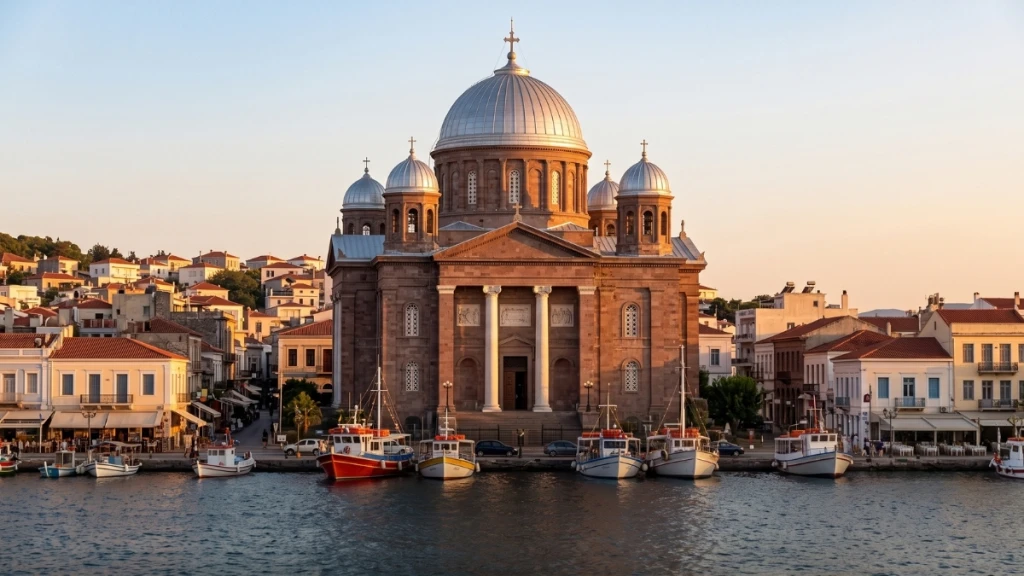
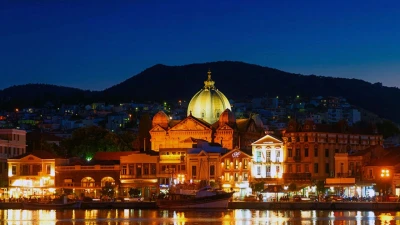
Saint Therapon Church is located in Midilli city center, near the harbor and the historic Ermou Street. Thanks to its tall central dome, four small corner domes, reddish stone facades, and monumental entrance, it is one of the first structures seen when approaching the island from the sea.
The church is not only a religious building; it is also regarded as an urban monument reflecting the economic, cultural, and architectural development of the Midilli Greek Orthodox community in the late 19th century. For this reason, Saint Therapon continues to be one of the most frequently used structures in Midilli photographs, postcards, and promotional images.
A sacred site whose history dates back to the 17th century
Although the current large church was built in the late 19th century, the religious and social activities in the same area go back much further. According to sources, there was once a small chapel dedicated to Saint Therapon on this site. The chapel was linked to a charitable institution that also functioned as a hospital at the time.
Written records regarding this institution are said to date back to 1692. Thus, the name Saint Therapon was associated with a religious center serving the sick, the poor, and those in need of care in this area nearly two centuries before the construction of the present monumental church.
A 130-year architectural story
Construction of the new Saint Therapon Church began in the late 19th century. It is reported that the building was opened for worship around 1900, while its official consecration ceremony took place in 1935.
The church was designed by Argyris Adalis, a native of Midilli. Adalis’s work with leading architectural circles in Athens can clearly be felt in the building’s design. In Saint Therapon, a Byzantine church plan is combined with neoclassical column orders, Gothic vertical emphasis, Baroque ornamentation, and local Midilli stone craftsmanship.
Impressive five-dome architecture
The building’s most distinctive feature is the large central dome surrounded by four smaller domes. This five-dome composition makes the church immediately recognizable in the Midilli city skyline.
The front facade stands out with marble columns, reliefs, and a symmetrical architectural layout. The reddish volcanic stones used on the exterior give the structure a strong character unique to Midilli. Inside, the wooden iconostasis, religious paintings, and historical icons are especially notable. It is said that the church houses a Saint Therapon icon dated 1651, as well as historical artifacts belonging to important religious figures.
Why was restoration necessary?
The church’s most serious problem for many years was rainwater entering through the domes and roofs. In particular, insulation and cladding issues on the central dome were threatening the interior plaster, painted surfaces, wooden elements, and electrical system.
Although previous partial repairs had temporarily reduced the problem, no permanent solution had been achieved. Because the historic building is located within a dense urban setting, the use of heavy equipment and cranes was also difficult, so the work was carried out using special scaffolding and high-altitude applications.
A 1.45 million euro restoration project
The announced budget for the main restoration project was approximately 1.45 million euros. The project was carried out under the coordination of the Greek Ministry of Culture and with support from the European Union’s Recovery and Resilience Facility.
Greek sources also mention different budget items related to roof and facade protection works. For this reason, the figures reported to the public can vary depending on the scope of the main restoration package and its related subprojects. The safest wording is that the main project began with a budget of 1.45 million euros and that interventions on the roof, domes, facade, and infrastructure were carried out in separate work packages.
What work was done as part of the restoration?
The most important stage of the restoration was the church’s five domes and roof system. The coverings, waterproofing, and connection points of the central dome and the four smaller domes were renewed. Openings and deteriorated sections on the roof surfaces that allowed rainwater to enter the building were repaired.
In addition, the electrical system was completely renewed, and a lightning protection system was installed to improve the building’s safety. Window frames, metal elements, and stone surfaces on the facade were also included in the protection works. Inappropriate old repair mortars were removed, while the stone joints were renewed with materials compatible with the original texture. Vegetation, biological contamination, soot, and metal oxide stains were reduced.
In some sections, bird deterrent nets and protective systems were also installed to prevent birds from damaging the facade and decorative surfaces.
Is the restoration completely finished?
In July 2026, most of the roof, dome, joinery, and electrical works were officially delivered. However, official statements indicate that facade restoration and some complementary conservation works are still ongoing.
For this reason, rather than saying “the church restoration is completely over,” it is more accurate and technically reliable to say, “the main roof and dome restoration has been completed, while facade and complementary works continue.”
Why is the priest’s rain remark so meaningful?
The priest’s remark, “If water doesn’t leak inside when it rains, I’ll be grateful,” is not merely a humorous comment. The main goal of the restoration was to permanently stop the rainwater that had been entering through the domes and roof for years.
In historic buildings, the success of a roof repair is not understood at the opening ceremony; it becomes clear during the first heavy rains, seasonal temperature changes, and long-term use. Therefore, this sentence expresses the real performance criterion of the technical intervention in a remarkably simple way.
A must-see stop on a Midilli trip
Saint Therapon Church is located in a place that can be easily reached on foot in central Midilli. Along with the harbor area, Ermou Street, the New Mosque, the Çarşı Bath, and Midilli Castle, it is one of the buildings that should definitely be included in a city tour.
Its architectural details on the exterior, the character added to the city view by its domes, and the religious artworks inside make the church a special stop for both cultural travelers and photography enthusiasts. The restoration work is of great importance for passing this significant structure on to future generations in a safer and more authentic form.
Quick Facts: Saint Therapon Church Restoration
Location: Midilli city center, near the harbor and Ermou Street
Construction period: Late 19th century; opened for worship around 1900
Architect: Argyris Adalis
Main budget: Approximately 1.45 million euros
Main works: 5 domes, roof, electrical system, lightning protection, and facade protection
Current status: Main roof and dome works completed; some facade and complementary works continue
Frequently Asked Questions
Where is Saint Therapon Church?
The church is located in Midilli city center, near the harbor and Ermou Street.
When was Saint Therapon Church built?
The current monumental structure was built in the late 19th century and opened for worship around 1900.
How much was the restoration budget?
The announced budget for the main restoration project is approximately 1.45 million euros.
What was renovated in the restoration?
The large central dome and four smaller domes, the roof system, electrical system, and lightning protection system were renewed; facade and joinery protection works were also carried out.
Has the restoration been fully completed?
The main roof and dome works have been completed. According to official statements, some facade and complementary conservation applications are still ongoing.
Social Media Summary
The major restoration phase has been completed at Saint Therapon Church, which defines Midilli’s city skyline. Under the approximately 1.45 million euro project, the five domes, roof system, electrical infrastructure, and lightning protection system were renewed. The priest’s remark, “If water doesn’t leak inside when it rains, I’ll be grateful,” also reminded everyone that the real test of the restoration will come with the first heavy rains.
Sources and Editorial Note
Ministry of Culture of Greece – restoration and delivery announcements regarding Saint Therapon roofs
ERT News – 130-year history, architecture, and restoration process of Saint Therapon
Emprosnet – project launch, technical scope, and financing of the restoration
Local Lesvos press – reports on water leaks and the complementary restoration process