Sourlanga Tannery in Mytilene: The Industrial Heritage of Gera Gulf
Introduction
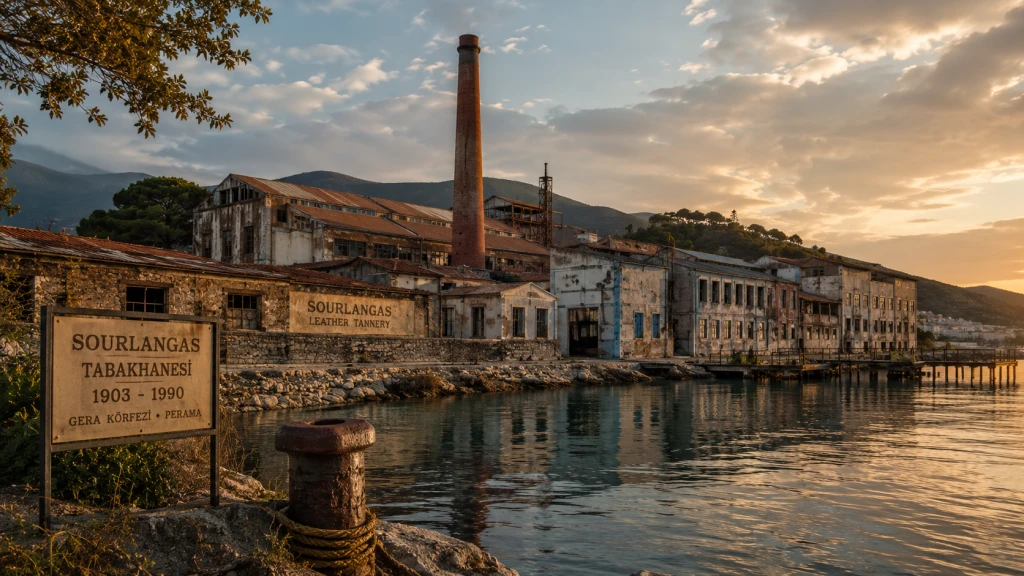
Mytilene Island is notable not only for its natural beauty and tourist attractions but also for its strong industrial past. The Sourlanga Tannery, located in the Perama region along the shores of Gera Gulf, is one of the most significant representatives of this heritage.
In this article, we discuss the process from the establishment to the closure of the Sourlanga Tannery, including its production technologies, economic impacts, labor structure, and the legacy that remains today.
Historical Development and Establishment Process
The commercial activities of the Sourlanga family begin with the first generations settling in the area. Over time, industry replaced trade, culminating in the establishment of the first tannery in Perama in 1903.
In 1925, the company transitioned to a joint-stock structure, accelerating its growth, and in the same year, a facility was established to produce tanning extract from acorns and pine bark. This development demonstrated that the factory had become not only a producer but also a supplier of industrial materials.
Between 1938 and 1958, new building investments expanded the facility, making it one of the most important industrial complexes in the region.
Industrial Scale and Production Capacity
Sourlanga Tannery is a large industrial complex spreading over 32.000 m² with approximately 30 buildings. Steam boilers and mechanical machines were employed in production processes.
In this context, the Babcock & Wilcox brand steam boilers played a critical role in the technological infrastructure of the facility.
The production process generally consists of the following stages:
- Preparation of raw hides (pre-treatments)
- Tanning (vegetable and chemical)
- Drying and processing
- Final processing and quality control
Particularly, the vegetable tanning method (using acorns) was the most significant factor defining the factory's early production character.
Labor Force and Work Life
The factory started operating with a few workers but over time transformed into a large enterprise providing employment for hundreds of people.
According to sources:
- Initial period: 5–6 workers
- Peak period: estimated between 250–550 employees
- Some sources: claims of 1000+ employees (not definitive)
The work system was largely paternalistic. In this model, the employer took on a role that influenced not only production but also the social lives of the workers.
Moreover, the factory's own boat transporting workers demonstrated the direct connection of production to the sea.
Economic Impact and Trade Network
Sourlanga Tannery was an enterprise with a trade network not only locally but also internationally.
Notable commercial connections:
- Raw hides: Romania and Russia
- Tanning raw materials (acorns): Turkey
- Exports: European markets (detailed data archived)
This structure illustrates that the factory was an important industrial bridge between the Aegean and the Balkans.
Environmental Impacts and Closure Process
Tanneries inherently involve high chemical usage. Over time, environmental impacts became a serious issue at the Sourlanga facility.
In particular:
- Wastewater pollution
- Damage to the Gera Gulf
- Social environmental reactions
These factors led to the decline of the factory starting in the 1970s and culminated in its complete closure in 1990.
Today’s Sourlanga: An Abandoned Industrial Heritage
After its closure, the factory was abandoned and gradually deteriorated. However, the most significant development was the preservation of its archive.
Covering the period from 1870 to 1990:
- Production records
- Employee payrolls
- Export lists
- Union documents
hundreds of documents have survived to this day.
This archive holds great importance for understanding the industrial history of the region.
Current Situation: Asbestos and Risk Discussions
In recent years, the most significant reason for the factory's renewed attention is environmental risks.
In particular:
- Asbestos-containing building elements
- Health risk discussions
- Application made to the prosecutor’s office in 2026
These developments indicate that the site should be addressed not only as a historical site but also as an environmental problem.
Conclusion
Sourlanga Tannery is one of the most significant structures representing Mytilene’s industrial past. This facility narrates:
- Industrial development
- Worker culture
- Regional trade
- Environmental transformation
simultaneously. Today, it stands as both a heritage that must be preserved and an environmental issue that needs to be resolved.