Radar Fine in Mytilene:
Handheld Radar, Pink Ticket, and the Reality of 50–60 km/h
A small traffic fine I experienced in front of Silver Bay Hotel showed me how different driving in Lesvos is from driving in Turkey.
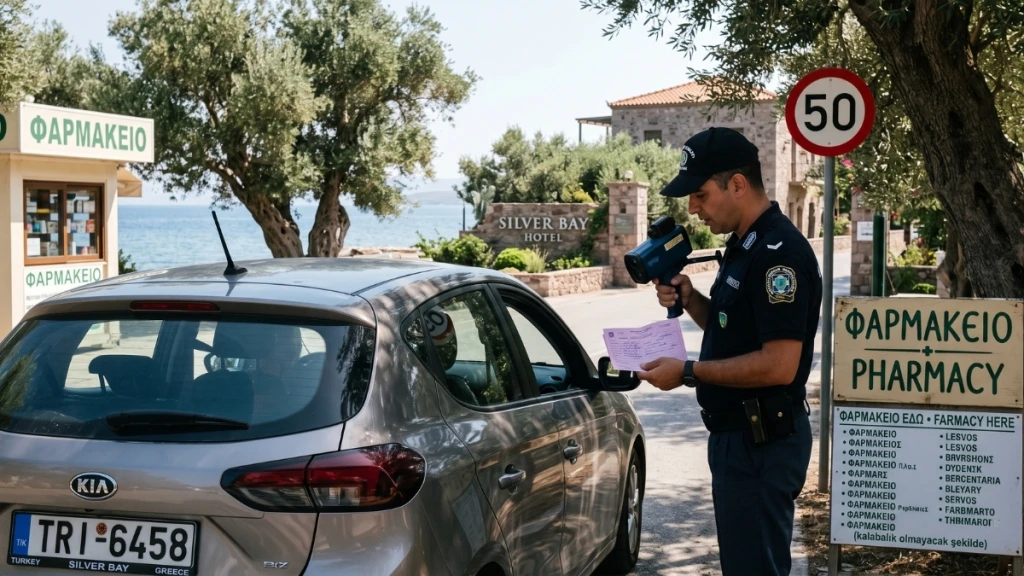
When driving in Mytilene, people first think of olive trees, stone villages, the sea, and quiet roads. For me, one more thing has now been added to the list: a traffic officer standing by the roadside holding an old-looking, L-shaped radar, followed a few minutes later by a pink-purple, handwritten fine ticket appearing in front of me.
The incident took place right in front of Silver Bay Hotel, on the Mytilene–Kalloni road. My speed was approximately 90 km/h. The police officer stopped me, told me the radar reading, and began filling out the report in the traditional way. What was interesting was not so much the fine itself, but how different the entire procedure seemed to me from Turkey.
The purpose of this article Not to dramatize a traffic fine, but to explain in an enjoyable way to Turkish visitors traveling to Mytilene by car or renting a car on the island how speed checks are conducted in Lesvos, why 50–60 km/h signs should be taken seriously, and what may surprise you during the fine process. |
Radar in front of Silver Bay: It was no coincidence
The official address of Silver Bay Hotel & Bungalows is the 5th kilometer of the Mytilene–Kalloni road. The good news is that when I researched the local Lesvos press, I discovered that this location is not unfamiliar when it comes to speed checks.
In 2024, the Empros newspaper noted that the Mytilene Traffic Police conducted speed checks starting around the 5th kilometer of the Mytilene–Kalloni road and continuing until several kilometers beyond the Gera junction. The same report also stated that there are 50 and 60 km/h speed-limit signs in these sections. In other words, being caught by radar in front of Silver Bay was quite consistent with the island’s usual checkpoints.
Source note: Silver Bay official address + Empros, 20.05.2024.
It was not the fine that surprised me, but the method
When most of us think of speed enforcement in Turkey, we think of EDS, fixed cameras, license-plate recognition, average-speed corridor systems, and fines appearing in the system later. The scene I encountered in Mytilene was almost a living example of analog traffic policing.
- The police officer was physically waiting by the roadside.
- The radar was handheld; it was an old-looking, L-shaped device.
- The vehicle was stopped on the spot.
- Identification and driver details were handwritten on a paper form.
- The form had separate lines for the father’s name and the mother’s name.
- The fine was not paid in cash to the officer; payment is made later through official channels.
Although it initially looked like a scene from the 1990s, the technical side is not quite so “old.” The official technical specifications of the Hellenic Police still include handheld speed-measurement devices. A 2024 police procurement document describes portable devices with laser sensors that are aimed at moving vehicles and display speed and distance on a screen.
An old-looking radar does not mean an invalid radar
I do not know the brand and model of the device I saw, so it would not be right to speak with certainty about its technical age. However, Greek traffic legislation explicitly allows speed checks to be conducted using special electronic or technical devices. In short, the fact that the device is not mounted on a large camera pole, does not take photographs, or is held by a police officer does not by itself invalidate the measurement.
For those who enjoy technical details The Hellenic Police’s 2024 specifications for portable speed meters describe handheld, laser-sensor-equipped devices that can display vehicle speed in km/h and distance on screen. So the “radar gun” appearance you see in Lesvos is not outside the logic of official police equipment. |
Why is everyone talking about 50–60 km/h in Mytilene?
For a Turkish driver in Lesvos, the biggest trap is trusting the appearance of the road. The road may be wide, the straight stretch long, and traffic light; but the sign may show 50 or 60. Moreover, this is not merely an issue that catches tourists’ attention; it has also been debated for years in the island’s own press.
An article published by StoNisi in 2025 explains that even on the island’s major national roads, speed limits are largely in the 50–60 km/h range, and that police use portable radar at some locations. The article also gives the example of a local driver who was fined while traveling at 67 km/h in a 50 km/h zone.
In 2026, the debate became even more current. The reduction of the speed limit from 60 to 50 km/h in some places along the Larsos–Kalloni section was seriously criticized in the local press. A former Lesvos Police Chief and former head of the Mytilene Traffic Department said that this road is periodically checked by radar and that the low limits could lead drivers to receive heavy fines.
So why are the limits so low?
Several reasons are highlighted in local debates: road geometry, lack of barriers, lighting poles, intersections, built-up area crossings, and the fact that the island’s road infrastructure is not up to highway standards. In some sections, lowering the speed limit is also criticized as a temporary or administrative solution used in place of physical safety measures.
The best driving rule in Lesvos Even if the road feels like a 90 km/h road, look at the sign. In Mytilene, the radar does not care if you think, “This road can’t possibly be 50 here.” |
Current Greek speeding fines:
The difference matters as much as the sign
Under Greece’s new Highway Traffic Code, N.5209/2025, the penalty becomes more severe not simply according to the logic of “I was speeding / I was not speeding,” but according to how much you exceeded the speed limit. The current general framework is as follows:
Speed-limit violation | General fine | Additional administrative measure |
Up to 20 km/h | €150 | Fine |
20–30 km/h | €150 | License confiscated for 20 days |
30–50 km/h | €350 | License + vehicle documents for 30 days |
More than 50 km/h | €700 | License confiscated for 60 days |
Note: This table summarizes the general speed-violation classification under N.5209/2025. There may be additional provisions for special circumstances, repeated violations, and different vehicle classes. The current signage and official report should always be taken as the basis.
A different amount was written on my own report, but I am not focusing on that figure in this article. Because for a driver traveling to the island, the real message is much more important: a 50 or 60 sign should not be treated as a minor suggestion.
Mother’s name, father’s name, and the handwritten pink form
One of the moments that made me smile most while the fine was being issued was when the police officer asked me, “your father’s name?” and “your mother’s name?” At first, I did not understand why this was necessary. Then, when I examined the form carefully, I saw that these were standard fields: the Greek form contains separate lines for the father’s name and the mother’s name.
As a foreign driver, your passport, license, and vehicle details are already checked; but the identity section of the paper form retaining the traditional Greek administrative approach is quite an interesting detail for someone coming from Turkey. And when all the information is written line by line with a ballpoint pen, seeing such a physical traffic-fine process still taking place in a modern European country can feel surprising.
“Do I have to pay the fine now?” No
Another important difference: the police do not ask you for money by the roadside. The fine is issued in an official report, and payment is made later through official channels. Greece’s current administrative-process guide states that traffic fines can be paid through ELTA (the Hellenic Post) or the cashier’s office of the municipality where the violation occurred.
Here is a small but important correction: do not think of it as “putting the fine in a mailbox.” Although ELTA is a postal institution, the transaction is a payment made through a counter or postal agency. This is why it is important to keep the old-style fine form.
Where should you check the payment deadline? Although general guides explain the payment channels and deadlines, the date/deadline and instructions written on the report in your possession take priority. Especially if you are a foreign driver, photograph the ticket and keep the proof of payment. |
Is it possible to appeal?
Yes. Under the current Greek administrative procedure, you have the right to appeal a traffic fine within three days of notification. The Hellenic Police states that an appeal can be submitted through gov.gr, by email to the unit that issued the fine, or in person when necessary.
This three-day period is particularly short. Therefore, if you believe there was an issue with the radar measurement, the vehicle, license plate, location, or a serious procedural error, the approach of “I’ll return to Turkey and look into it later” may be risky.
Greece is also going digital;
but Lesvos is still a little ‘old school’
The nicest part is that just as I was wondering, “How is this still being written by hand?”, the Hellenic Police was already conducting a pilot program to transition to digital traffic fines. According to the official statement from May 2026, the purpose of the system is a gradual transition from handwritten fines to digital fines. Smart cameras and digital verification systems are also being used during the pilot phase.
So the pink-purple paper I saw is not really a picture of Greece “not knowing technology,” but rather a charming snapshot of the fact that the digital transformation has not yet been completed at the same pace everywhere. Athens can be one world, while the roadside in Lesvos can be another.
What is the biggest difference between Turkey and Mytilene?
Topic | What we are used to in Turkey | What you may encounter in Lesvos |
Speed checks | EDS, fixed cameras, and corridor/automatic systems are widespread | Police by the roadside + handheld radar are still perfectly normal |
Fine notification | Fines later recorded against the plate/in the system are common | The driver may be stopped on the spot and receive a paper report |
Identity information | Mostly digital records | Form fields, including mother’s/father’s name, may be completed by hand |
Payment | Strong habit of online payment | Traditional channels such as ELTA / the municipal cashier are still used |
Technology | Extensive license-plate and camera automation | Digital system in expansion/pilot transition phase in 2026 |
10 practical tips for Turkish drivers who will drive in Mytilene
- Take the speed sign more seriously than the physical quality of the road. A wide and empty road can still be 50 km/h.
- Remember that there may be speed checks along the Mytilene–Kalloni route, particularly around Silver Bay, the Gera junction, and the sections beyond it.
- Using cruise control or a limiter at 50–60 km/h signs is very useful.
- Do not expect the radar to be a fixed camera; roadside checks can be carried out with a handheld device.
- If the police stop you, have your passport/ID, license, and vehicle documents ready.
- If you are driving a rental car, keep the contract and vehicle documents in the car.
- Take photographs of both the front and back of the paper fine form.
- Do not try to pay the fine directly to the police; use the official payment channel shown on the form.
- If you are going to appeal, do not miss the short three-day deadline.
- Most importantly: do not hurry on the island. Lesvos is not an island to rush through, but one to explore slowly.
Frequently asked questions
Are there fixed speed cameras in Mytilene?
Digital and fixed systems are developing in Greece; however, it is entirely possible to encounter portable speed meters used by police on the roadside in Lesvos.
Does the radar have to take a photograph?
Speed checks can be conducted using special electronic/technical devices. In checks where the driver is stopped on the spot, the process may proceed differently from Turkey’s automatic fine system based on the license plate.
What is the normal speed in Mytilene?
There is no single island-wide figure. Follow whatever the sign says. However, local sources show that 50–60 km/h limits are very common even on major roads.
Where is the fine paid?
Payment is made through the official channel according to the instructions on the report. The current administrative guide lists ELTA and the relevant municipal cashier among the payment options.
Should the fine be paid immediately after receiving it?
Payment is not made to the officer by the roadside. The deadline and payment method should be followed according to the instructions written on the report.
How long is the appeal period?
Under the current official procedure, three days from notification.
Final word:
Even the radar in Mytilene suits the island’s spirit a little
This small traffic story I experienced in front of Silver Bay became an interesting cultural detail for me, beyond the fine itself. On one side, the calm Aegean road; on the other, a police officer waiting with a radar in hand; followed by being asked for my mother’s and father’s names, the pink-purple paper being filled out with a ballpoint pen, and ELTA stepping in for payment…
Seen from Turkey, it looks a little old-fashioned, a little surprising, and even somewhat charming. But jokes aside, the rules are real and the fines are quite serious under the new Highway Traffic Code. That is why the best driving advice in Mytilene is very simple: follow the signs, be patient in 50–60 km/h zones, and measure the island not by speed but by the scenery.
In short It is easy to say “don’t speed in Mytilene”; the real advice is this: in Lesvos, trust the sign, not the appearance of the road. Because that old-looking radar may be more serious than you think. |
Sources and verification notes
Research date: September 7, 2026. The sources below were used to verify the article’s legislation, radar technology, payment/appeal procedures, and local speed-limit debates in Lesvos.
1. Hellenic Parliament – N.5209/2025, Highway Traffic Code (FEK 100 A’/13.06.2025)
https://www.hellenicparliament.gr/nomothetiko-ergo/anazitisi-nomothetikou-ergo?law_id=7377b0f9-4ac6-404a-9f2d-b2ee000f5b7f
2. ELINYAE – N.5209/2025, Article 24 speed limits and speed-violation classifications
https://www.elinyae.gr/en/node/75564
3. Hellenic Police – Pilot operation of the Digital Traffic Violation Detection System, 30.05.2026
https://www.astynomia.gr/2026/05/30/30-05-2026-pilotiki-leitourgia-tou-systimatos-psifiakis-vevaiosis-paravaseon-odikis-kykloforias/
4. Hellenic Police – Technical specifications for portable vehicle speed-control devices (RADAR), 2024
https://www.astynomia.gr/file/2024/03/06032024exoplismosodikisasfaleias.pdf
5. Greek National Registry of Administrative Procedures (MITOS) – Enforcement and payment/appeal procedure for Highway Traffic Code fines
https://mitos.gov.gr/index.php/%CE%94%CE%94:%CE%95%CF%80%CE%B9%CE%B2%CE%BF%CE%BB%CE%AE_%CE%A0%CF%81%CE%BF%CF%83%CF%84%CE%AF%CE%BC%CF%89%CE%BD_%CE%B1%CF%80%CF%8C_%CE%A0%CE%B1%CF%81%CE%B1%CE%B2%CE%AC%CF%83%CE%B5%CE%B9%CF%82_%CE%9A.%CE%9F.%CE%9A
6. Hellenic Police – Guide to appealing traffic fines
https://www.astynomia.gr/enstaseis-trochaias/enstaseis-trochaias-ellinika/
7. Empros Lesvos – “The 50 and 60 km limits on the national road are surprising!”, 20.05.2024
https://www.emprosnet.gr/article/ksenizei-to-orio-ton-50-kai-60-xil-stin-ethniki-odo
8. StoNisi – “Speed limits for… flamingos!”, 19.03.2025
https://drct.stonisi.gr/post/89528/oria-taxythtas-gia-flamingko
9. Ta Nea tis Lesvou – Debate over reducing the Larsos–Kalloni speed limit from 60 to 50, 27.04.2026
https://nealesvou.gr/paremvasi-tou-astynomikou-diefthynti-en-apostrateia-michali-koufelou-ypervoliki-i-meiosi-tou-oriou-tachytitas-se-ethniko-dromo/
10. Silver Bay Hotel & Bungalows – Official contact/address page (5th km Mytilene–Kalloni)
https://www.silverbay.gr/en/%CE%B5%CF%80%CE%B9%CE%BA%CE%BF%CE%B9%CE%BD%CF%89%CE%BD%CE%AF%CE%B1/