Osmanlı Legacy: A Heritage Story from the Ottoman Era to the Present
Introduction: Silent Witnesses of Lesvos
Located in the north of the Aegean, opposite Ayvalık, the island of Midilli (Greek: Lesvos) is captivating not only for its natural beauty but also for its multi-layered history.
During the Ottoman period, one of the island’s most respected Muslim families, the Kulaksızzâdes, represents a past that still echoes today in the island’s stone walls, quiet courtyards, and half-ruined mosques.
This article examines the origins of the Kulaksızzâde family, their influence in Lesvos, their architectural legacy, and archival sources in Greek and Ottoman records.
1. The Family’s Identity and Place in Ottoman Society
1.1. Meaning of the Name and Lineage
The name “Kulaksızzâde” is a structure frequently encountered in Ottoman onomastics: it means “sons / descendants of Kulaksız.”
This title was generally used for families in the provinces who were distinguished, educated, or had held administrative positions.
1.2. Their Role in Lesvos
The name that stands out in archival records is Kulaksızzâde Mustafa Ağa, who served as Midilli Nazırı (local administrator) in the early 19th century.
This title represented both administrative and financial authority. Mustafa Ağa was not only an administrator, but also a bearer of an architectural legacy that left lasting traces on the island.
2. Yeni Cami (Γενί Τζαμί): The Family’s Signature Carved in Stone
2.1. Foundation and Architecture
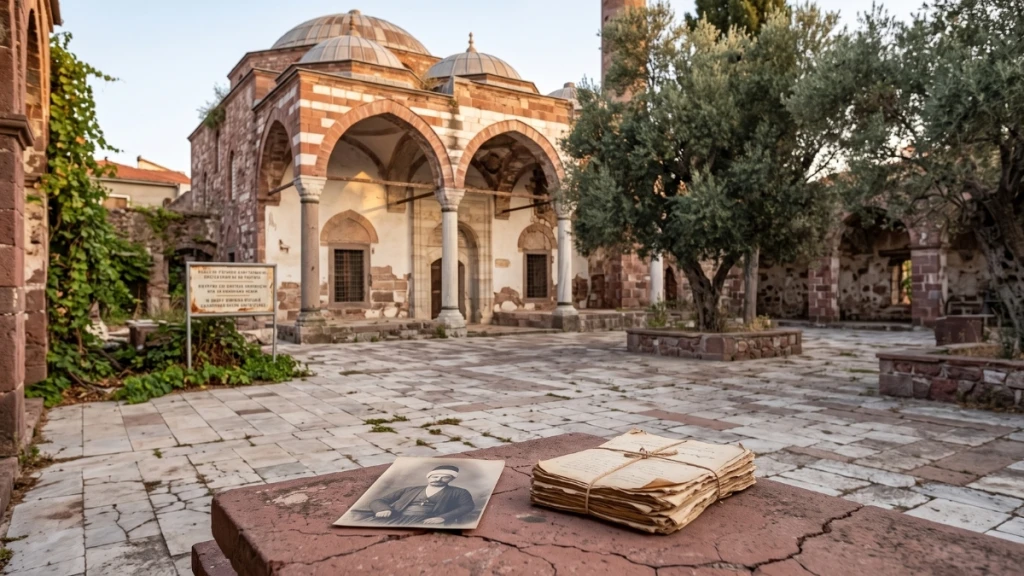
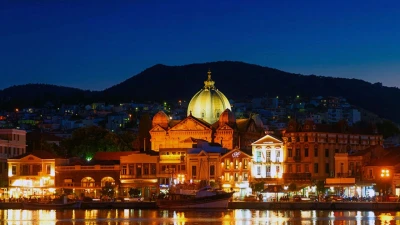
Yeni Cami was built around 1825 by Mustafa Ağa Koulaksiz (Kulaksızzâde).
The structure rose in the Epano Skala district of Lesvos, in the heart of the old Turkish bazaar.
The complex consists of a mosque, madrasa, mufti rooms, and a hazire (graveyard) section.
The building material is a combination of the island’s characteristic red stone and white mortar.
The dome and arches reflect classical Ottoman influences, while the exterior shows local stone craftsmanship.
📍 Location: Epano Skala, Mytilene
📅 Year Built: 1825
🏗️ Patron: Mustafa Ağa Kulaksızzâde
🕌 Greek Record: “Μουσταφά Αγά Κουλαξίζης” (Greek Ministry of Culture Inventory, Odysseus Portal)
2.2. Decline and Restoration Efforts
After the 1923 population exchange, the Muslim population left the island, and Yeni Cami was closed to worship.
In 1956, it was declared a “Historic Monument” by the Greek Ministry of Culture.
In 1979 and again in the 2000s, restoration projects were proposed twice, but no comprehensive renovation could be carried out.
In 2011, an initiative for environmental cleaning and preservation was launched by volunteers.
Today, the structure is used in a limited way for cultural events and exhibitions.
📸 [Photo placeholder: Exterior of Yeni Cami, 2023]
3. The Inheritance Case: A Woman’s Struggle in Ottoman Law
3.1. Summary of the Case
After Mustafa Ağa’s death (circa the 1830s), a dispute over inheritance division turned into a woman’s claim to inheritance rights in the Ottoman provinces.
This case reached the Meclis-i Vâlâ (the high court in Istanbul) from the local courts.
3.2. Social Significance
The case entered Ottoman legal history as one of the rare examples in which women were able to defend their property rights.
In academic literature, this event is evaluated as a turning point for women’s legal representation in the provinces.
(Akay & Aydın, A Law Struggle of Women: Midilli Minister Kulaksızzade Aga Mustafa Case, 2021)
4. “Κουλαξίζης” in Greek Sources
In the records of the Ephorate of Antiquities of Lesvos, affiliated with the Greek Ministry of Culture, the following statement appears:
“The Yeni Mosque was erected around 1825 by Mustafa Ağa Koulaksiz, governor of Mytilene.”
(Yeni Cami was built around 1825 by Mustafa Ağa Kulaksizis, governor of Midilli.)
This statement fully matches the Turkish record of “Kulaksızzâde Mustafa Ağa.”
Moreover, in Greek documents, the family is described as “Μουσουλμανική ευγενής οικογένεια της Μυτιλήνης” — that is, “the Muslim noble family of Midilli.”
5. Today: Silent Witnesses and Cultural Dialogue
The traces of the Kulaksızzâde family still live on in the streets of Lesvos today.
Local people still refer to the neighborhood where the mosque is located as “του Κουλαξίζη το μέρος” — “Kulaksizis’s place.”
The mosque ruins are like a symbolic window opening onto the shared past of two communities.
Cultural heritage institutions in Greece have raised the idea of evaluating the mosque in the future as an intercultural dialogue center.
Such projects are powerful symbols that can carry the traces of the past into the future in Turkish-Greek relations.
Conclusion
The Kulaksızzâde family is one of the clearest representatives of Lesvos’s social and architectural identity during the Ottoman period.
Structures like Yeni Cami are not merely stone buildings, but historical witnesses resonating in the shared memory of two peoples.
Even if the stones are silent today, each one tells a story:
The vision of an administrator, the faith of a family, and the multicultural spirit of an island...
Bibliography
Akyılmaz, Gül. Property Rights in the Ottoman State and the Legal Status of Women. Istanbul University Press.
Aydın, Elif. A Law Struggle of Women: Midilli Minister Kulaksızzade Aga Mustafa Case. Academia.edu, 2021.
Greek Ministry of Culture, Odysseus Cultural Portal – culture.gov.gr
Lesvos Ephorate of Antiquities, Mytilene Records, 2018.
Yeni Mosque, Mytilene (Γενί Τζαμί) – Wikipedia EN & EL.
Abandoned Spaces: Yeni Mosque in Mytilene, 2023.