THE RHYTHM OF THE NIGHT IN LESVOS
A Traditional Greek Night with Sokratis
Live music, rooted dances, a fiery stage, and an unforgettable party that brings the entire tavern together in a circle
21:00–23:30 Sample program | 2 LIVE MUSICIANS Bouzouki, keyboard, and vocals | 4 DANCERS Typically 2 women + 2 men |
A night bringing the two shores of the Aegean together at the same table.
This journey begins at taverna tables; from the sponge divers of Kalymnos to the seasoned hasapikos dancers of Istanbul, from the inner world of zeibekiko to the exuberance of Zorba. By the end of the night, no one is left watching: everyone is inside the dance.
More Than a Show: The Spirit of Glenti
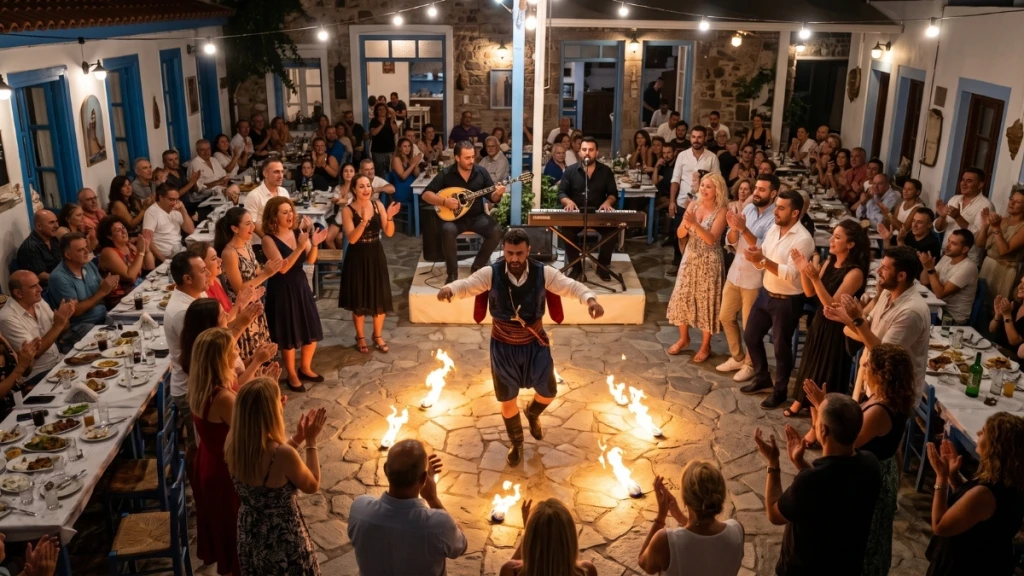
As evening falls in Lesvos, the tavern slowly comes alive. Mezze dishes arrive at the tables, glasses are filled, and conversations deepen. Then, the first melody rises from the bouzouki strings. Sokratis greets his guests, the dancers take their places, and people who were only looking at each other a few minutes ago soon begin clapping to the same rhythm.
What the Greeks call "glenti" is exactly this: a shared celebration where food, live music, dance, and friendship naturally blend together. A glenti does not draw a sharp line between stage and audience. First, you watch; then your feet start moving to the rhythm; before long, you find yourself holding the hand Sokratis extends to you.
What makes the night prepared by Sokratis and his dance team special is precisely this transformation. The program is not just a sequence of dances strung together. Each segment tells another story; each story draws the guests deeper into the heart of the night.
The Heroes of the Night: Sokratis, Dancers, and Live Music
At the center of the night stands Sokratis Kouroulis: host, dancer, instructor, and storyteller. His role is not merely to step onto the stage. He reads the energy of the guests, communicates with the musicians, puts shy guests at ease, and gradually raises the tempo of the night.
The team includes Anastasia Kourouli, Niki Despotelli, Maria Fotini Evangelou, Litsa Frantzeskaki, and Thodoris Zervas. During events, typically two women and two male dancers take the stage; the roster and dance order may vary depending on the structure of the organization.
Two live musicians accompany the performances. Thanks to the live interaction between bouzouki, keyboard, and vocals, the program does not become mechanical. The musician responds to the dancer's movements; the dancer responds to the guests' applause. Thus, every night develops its own unique rhythm and memory.
21:00 — Glasses Raise, The Night Begins
At 21:00, the program opens with Sokratis's warm welcome. The dance team is introduced, the first glasses are clinked at the tables, and live Greek music envelops the tavern. This beginning prepares the guest for the spirit of the night rather than immediately plunging them into an intense show.
Then come folk dances selected from Lesvos and various regions of Greece. The fluid movements of island dances, the circle and line formations, demonstrate the importance of moving together within a community. While the repertoire may vary depending on the event, the core idea remains the same: to bring together different regions of Greece within a few steps and melodies.
Sirtaki Lesson — For Those Who Say "I Can't Dance"
Sokratis invites guests onto the stage with a short and fun sirtaki lesson. Prior dance experience is not required. Simple steps are repeated, shoulders join together, and the group's common rhythm is gradually established. No one is eliminated for taking a wrong step; often, the most laughter rises right at that moment.
Although sirtaki is often thought of as an ancient folk dance, its current form was created for the 1964 film "Zorba the Greek." Combining elements of slow hasapiko and fast hasaposerviko, the dance became one of the global symbols of Greek joy thanks to Mikis Theodorakis's unforgettable music. Its progression from slow to fast makes it perfectly suited to include people of all experience levels in the same dance.
These few steps learned early in the night are actually a harbinger of the finale. When guests hear the Zorba melody again, they are ready not just to watch, but to become part of the dance.
22:00 — The Sponge Diver of Kalymnos:
The Touching Story of Mihanikos
One of Sokratis's most impressive character performances is the story of an elderly sponge diver trying to dance with his cane. Behind the seemingly humorous movements lies a heavy maritime memory of the Aegean.
For centuries, Kalymnos was known for sponge diving. In the 19th century, the use of heavy diving suits called "skafandro" allowed divers to go deeper and stay longer. However, decompression sickness caused by rapid ascent resulted in paralysis, walking difficulties, or death for many divers.
This history finds expression in the "Mihanikos" sponge diver dance. The lead dancer leans on his cane; his legs tremble, his balance falters, and he sometimes appears about to fall. While the young people beside him move with strength and freedom, he tries to rejoin the rhythm despite all the hardship.
In Sokratis's interpretation, humor is used not to belittle the character, but to connect with the audience. At the heart of the show are resilience, acceptance, and a will to live. Even if the body changes, the human desire to participate in music, community, and celebration never fades. Therefore, the "Sponge Dance" is one of the night's most amusing yet thought-provoking segments.
Lesvos's Traditional Chair Dance
One of the segments that strengthens the local identity of the program is the traditional Lesvos chair dance, masterfully presented by Sokratis. Here, the chair ceases to be a simple stage prop; it becomes a partner in storytelling around which the dancer moves, demonstrating balance and control.
Sokratis's stage dominance is particularly evident in this performance. Through his body language, sense of rhythm, and communication with the audience, the dance becomes both a local cultural element and a powerful stage show. Within a program featuring dances from various regions of Greece, the host island of Lesvos receives a special signature.
22:40 — Hasapiko: Shoulder-to-Shoulder Harmony
When hasapiko begins, individual movement gives way to flawless group harmony. The dancers stand shoulder to shoulder; steps, direction changes, and small accents happen simultaneously. One person's movement is not independent of the others. The dance makes trust and teamwork visible.
The roots of hasapiko extend to Constantinople, i.e., Istanbul. The name is associated with the meaning "butchers' dance," and it is believed to have developed from mock battles performed by butcher guilds during the Middle Ages. Over time, it joined the city's entertainment culture and the rebetiko repertoire, becoming one of the most recognized collective dances in Greece.
Hasapiko forms the basis of the slow section of sirtaki. Therefore, after watching hasapiko in the program and joining the Zorba finale, the guest gets the opportunity to experience two different faces of the same dance language: first measured and controlled, then increasingly fast and passionate.
Zeibekiko — The Moment a Person Stands Alone with Music
While the community stands shoulder to shoulder in hasapiko, zeibekiko opens space for a single individual. This dance is mostly solo and improvised. Rather than flawlessly executing a fixed choreography, what matters is the personal relationship the dancer establishes with the music.
The historical world of zeibekiko is connected to the Aegean's zeybek culture, the cities of Asia Minor, and later rebetiko developed in Greece. While sharing the same historical basin as the zeybek games in Turkey, modern zeibekiko is a distinct social dance form.
The dancer sometimes advances with heavy steps, sometimes kneels, and sometimes remains motionless for a few seconds to carry the weight of the song. Spectators clap to the rhythm but respect the dance floor. Because zeibekiko is often less a show for outsiders and more a short story made visible through which a person reveals the love, longing, pride, or grievance they carry within.
Sokratis's Signature: Zeibekiko Fire Performance
One of the most striking moments of the night is Sokratis's unique zeibekiko fire show. The light of the flames, the rising tension of the live music, and Sokratis's controlled movements gather all attention in the tavern to a single point.
This segment combines the individual expressive power of traditional zeibekiko with Sokratis's theatrical stage language. Fire is not a mandatory or historical part of every zeibekiko in the program; it is Sokratis's personal signature added to the show. It is one of the performances that most strongly reveals his identity as a dancer, his courage, and his stage mastery.
Love, Humor, and Memories Told Through Dance
Special performances are not limited to named folk dances. Choreographies prepared over selected songs played live convey joy, romance, flirtation, longing, and humor through body language.
A glance, two dancers approaching each other, a sudden change of direction, or an exaggerated facial expression can make the story of a song even if you don't know the words understandable. It is no coincidence that guests from Turkey easily connect with these segments. Although different languages are spoken on the two shores of the Aegean, there is a vast shared culture where rhythms and emotions touch each other.
23:00 — Zorba Begins: Now Everyone Is Standing
As 23:00 approaches, the familiar Zorba melody rises. The sirtaki steps learned earlier in the night are recalled; Sokratis and the dancers invite guests to join them. Shoulders join, and the first steps are taken calmly.
As the music speeds up, the circle grows. People who were sitting at different tables a moment ago now move within the same rhythm. While directing the steps, Sokratis also keeps the energy of the entire tavern alive. Applause multiplies, laughter rises, and the fun transcends the boundaries of the stage.
This moment fulfills the night's true promise: culture watched becomes an experience lived.
Tsiftetelli — A Familiar Rhythm for Both Shores of the Aegean
The excitement of the finale continues with tsiftetelli. This free and lively dance shares the same cultural family as the Turkish çiftetelli; it is one of the interpretations of rhythms traveling across Anatolia and the Balkans in Greek entertainment life.
After the common step pattern of sirtaki, tsiftetelli offers guests a freer space. Women and men can join the rhythm individually, in pairs, or in groups, using their own styles. Feeling the music is more important than exact steps.
That is why it is one of the segments where guests from Turkey join in the fastest. The rhythm is not foreign; it simply reappears on the opposite shore of the Aegean with another interpretation.
23:30 — Music Ends, Memories Remain
After the final dances, Sokratis, his teammates, and the musicians thank the guests. As the tavern slowly calms down, the favorite moments of the program are discussed at the tables: the sponge diver getting back on his feet with his cane, the mastery in the chair dance, the zeibekiko amidst the flames, or the steps mixed up during Zorba but completed with laughter...
From a traditional Greek night, nothing remains but the shows watched. A glass raised together, a step taken shoulder to shoulder with someone you didn't know, and the shared excitement created by live music become an unforgettable part of the journey.
Where Can It Be Organized?
The program is mostly held in tavernas that offer the natural environment of a genuine Greek night. Food, live music, and dance complement each other in the same venue. When appropriate technical and safety conditions are met, it can also be organized in open-air areas, hotels, private parties, and corporate events.
In organizations featuring a fire performance, the venue's suitability for open flame use, a safe display area, and necessary operating permits must be evaluated in advance.
Why Should You Experience This Night?
Because truly knowing Lesvos is not completed just by walking its streets or seeing its coasts. You need to hear the island's music, watch a local dance, and celebrate together at the same table.
Sokratis and his team offer guests a participatory night beyond a staged folklore show. From children to adults, from those who know how to dance to those experiencing sirtaki for the first time in their lives, everyone can find a moment that belongs to them.
If you want to return from your vacation not only with photos but also with a melody still ringing in your ears and a smile forming on your face, this night is exactly for you.
Sources and Cultural Reading