Pitsiladi Ouzo
A 130-Year Family Distillery Stretching from Bergama to Plomari and the Ouzo Heritage of the Aegean
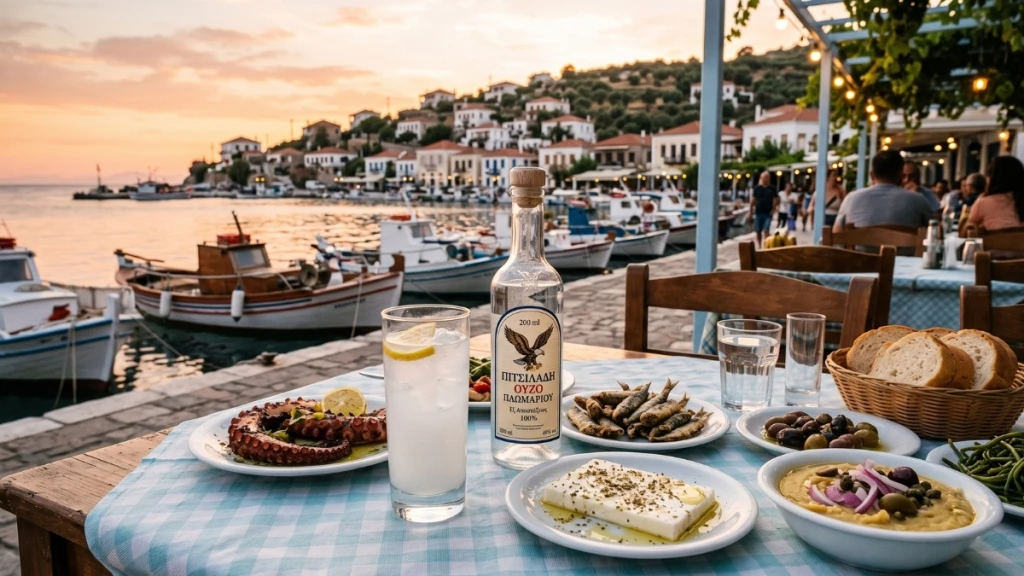
Photo: 200 ml Pitsiladi Ouzo served in Plomari (%40 vol.)
Pitsiladi Ouzo, originating from a family from Bergama and produced in Plomari on Lesvos, is a historic ouzo brand continued since 1892. With its 100% distilled character, copper stills, olive-wood fire, and classic eagle label, it stands among Plomari’s living gastronomic heritages.
Plomari at a tavern table may, at first glance, seem like nothing more than a local ouzo. Yet this bottle brings together the family memory carried from Bergama to Lesvos, a production license obtained during the Ottoman period, the industrial history of Plomari, and a traditional distillation culture still carried on in copper stills—all on a single label.
What Is Pitsiladi Ouzo?
The Greek name of the product in the photo is “Πιτσιλαδή – Ούζο Πλωμαρίου.” It can be translated into Turkish as “Pitsiladi Plomari Ouzo.” The label states “Εξ Αποστάξεως 100%,” indicating that the product is 100 percent distilled. The bottle shown here is 200 milliliters and has an alcohol content of 40 percent.
The back label clearly explains the production character: family recipe, small-scale production, distillation of aniseed and grains, traditional copper stills, and olive-wood fire. These details make Pitsiladi not merely an aromatized spirit, but a gastronomic product tied to a specific place and production tradition.
The Story Begins in Bergama
According to Greek gastronomic sources, the Pitsiladis family story begins in Bergama in the early 19th century. It is said that some of the family’s ten siblings went to Istanbul, while Panagiotis and Yannis Pitsiladis moved to Lesvos in the mid-19th century and settled in Plomari. The two brothers are reported to have established their first distillery on the banks of the river running through the town.
In some local narratives, the founder’s name also appears as Vasileios Pitsiladis. This variation may stem from the differences often found in oral histories and intergenerational transmission in family businesses. However, the main points shared by the sources are clear: the family is of Bergama origin, production began in Plomari in the 19th century, and the business received official authorization in 1892.
A Link Between the Two Shores of the Aegean
Pitsiladi’s history extends to a period before the forced migrations after 1922. The family’s move from Bergama to Plomari is an example of the commercial, maritime, and craft mobility of the Ottoman Aegean world.
1892: The First Official License from the Ottoman Administration
The official founding date of the Pitsiladi distillery is considered to be 1892. Greek sources state that the family received its first official operating license from the Ottoman authorities governing Lesvos at that time. Considering that Lesvos remained under Ottoman rule until 1912, this document directly connects the brand’s history to the Ottoman period.
For this reason, Pitsiladi is not merely an old Greek spirit brand. It is also a concrete example of how the Aegean world—today divided by the borders of Turkey and Greece—once functioned as a shared economic and cultural space.
Why Did Plomari Become the Capital of Ouzo?
Plomari became an ouzo center for more than one reason. The town’s port, proximity to the Anatolian coast, strong maritime trade, olive oil and soap production, copper craftsmanship, and small family workshops all converged in the same economic ecosystem. By the late 19th century, small distilleries known as “rakaria” had multiplied; ouzo production became one of the main occupations defining the town’s identity.
The old workshops around Plomari’s river provided access to water and the port. Transporting raw materials, storing products, and shipping them to Aegean ports was easy. When the distillation knowledge brought by producers from Anatolia merged with Lesvos’ anise, olive culture, and maritime trade, Plomari created its own distinct ouzo school.
The Meaning of the Eagle Label
The spread-winged eagle at the center of the Pitsiladi bottle is the brand’s most powerful visual symbol. According to sources, the products began to be sold in labeled bottles from 1928 onward, and the first labels featured the eagle figure. In 1950, a new design dominated by yellow, red, and cream tones was created; the eagle was preserved and remained at the center of the brand identity.
The label we see today is more than a modern “retro design” exercise. It carries a genuine commercial identity that has continued for about three-quarters of a century. The eagle can be interpreted as symbolizing strength, continuity, and expansion into distant markets. At the same time, it reflects Pitsiladi’s survival across generations while remaining a small-scale producer.
A Distillery Continued Across Generations
After the founder’s generation, the business passed to children and grandchildren. Greek sources indicate that management was continued by Yannis Kleidaras from 1984 onward. In the past, the distillery also produced wine, brandy, or liqueur-type products besides ouzo; from the mid-1980s onward, it shifted entirely to ouzo.
Compared with large industrial brands, Pitsiladi’s scale is limited. Old gastronomic sources give annual production as approximately 30,000 liters. This figure should be read not as a current capacity figure, but as a historical datum showing the brand’s boutique scale.
What Does “100% Distilled” Mean?
Not every ouzo is made from the same proportion of distilled aromatic spirit. In the broader ouzo category, neutral agricultural alcohol and aromatic distillate may be blended according to certain rules. However, products bearing the “Ouzo Plomariou” geographical indication are subject to stricter conditions.
- The product must be produced in a distillery within the Plomari municipal area.
- The final product must contain at least 40 percent alcohol by volume.
- All of the total alcohol must come from distillation carried out with aromatic substances.
- Distillation must be performed in traditional batch-operated copper stills.
- The technical file sets a 1,000-liter upper limit for still capacity.
Therefore, the “Εξ Αποστάξεως 100%” statement on the bottle is not merely a marketing phrase. It describes the technical and legal standard of the Plomari geographical indication.
Copper Still and Olive-Wood Fire
Copper is an indispensable material in traditional distillation. It conducts heat evenly and, during distillation, may contribute to a cleaner aroma profile by interacting with certain unwanted sulfur compounds. In a batch system, each batch is prepared separately; the distiller separates the head, heart, and tail fractions through experience.
Pitsiladi’s most distinctive detail is that the stills are heated with olive-wood fire. Olive wood is a dense fuel that burns long and steadily. Compared with automatic steam systems, this method requires more skill; the flame, temperature, and distillate flow must be monitored continuously.
Important Detail
Olive-wood fire does not give the spirit a direct smoky or charred aroma. The wood is an external energy source that heats the enclosed copper still. Its effect appears mainly in managing the distillation speed and temperature profile.
Anise, Grains, and the Plomari Recipe
The Pitsiladi label clearly mentions aniseed and grains. The official technical file of Plomari Ouzo highlights Lisvori anise. Lisvori is a village near Kalloni Gulf known for anise production on Lesvos. The region’s sun, soil, and dry climate contribute to the volatile oil character of the anise.
Plomari recipes may include fennel, star anise, coriander, cardamom, cinnamon, mastic, barley, or other botanical ingredients depending on the producer. However, the proportions are a family secret. Since Pitsiladi’s exact recipe is not disclosed, it would be incorrect to present spices not indicated on the label as the product’s definite ingredients.
Some Greek gastronomic accounts say that anise and grains used in Pitsiladi production are soaked in seawater. This detail appears in secondary sources concerning the producer’s family method; it is not explicitly stated on the bottle label.
Why Does Ouzo Turn White When Water Is Added?
The turning of ouzo to milky white when it comes into contact with water or ice is known as the “ouzo effect.” Anethole, one of anise’s main aromatic components, dissolves at high alcohol levels; when water is added, its solubility decreases. Tiny oil droplets disperse throughout the liquid and scatter light, causing the spirit to appear cloudy white.
This is not a sign of spoilage. It is the natural physical behavior of anise-flavored distillates. The intensity of whitening varies according to anethole content, temperature, alcohol strength, and the amount of water added.
The Cultural Importance of Ouzo for Plomari
In Plomari, ouzo is not merely an alcoholic beverage, but the rhythm of social life. Ship launches, the completion of olive harvests, weddings, baptisms, and local festivals have been celebrated around ouzo tables. Ouzo gains meaning with small meze plates, seafood, long conversations, and slow consumption.
Lesvos’ official tourism sources describe the island’s ouzo distillation tradition as a heritage of about two centuries. Ouzo museums established in Plomari and the annual Ouzo Fest event have brought this production culture to the center of gastronomic tourism.
Ouzo Fest has been held in Lesvos since 2013 and brings together dozens of ouzo brands, local producers, island meze, and visitors. This festival shows that ouzo is not just a commercial product; it is also a cultural, tourism, and local economic brand of Lesvos.
What Makes Pitsiladi Special?
- Its roots in a Bergama family story
- Its official history tracing back to an 1892 Ottoman license
- Its representation of the old riverbank distillery culture of Plomari
- Being a 100% distilled Plomari ouzo
- Using traditional copper stills and olive-wood fire
- Preserving its identity as a small family production
- Continuing the eagle symbol from 1928 and the classic label shaped in the 1950s
- Making visible the historical production and cultural connection between the two shores of the Aegean
How to Serve It, and What to Eat With It
A Plomari ouzo with a strong aroma like Pitsiladi is better suited to accompanying a long table than being consumed quickly as a shot. One may pour the ouzo into a glass first and then add cold water; if ice is used, adding it after the water helps the aromas open more evenly.
- Grilled octopus, calamari, and sardines
- Salted fish, lakerda, and mackerel
- Lesvos’ ladotiri cheese
- Fava, olives, capers, and sea fennel
- Grilled vegetables and garlicky meze
Conclusion: More Than a Bottle
Pitsiladi is the distilled form, since 1892, of a family memory carried from Bergama to Plomari.
This small bottle brings together a story of an Ottoman-era license, Plomari’s port and industrial past, Lesvos anise, copper craftsmanship, and olive culture. Pitsiladi’s value lies not only in its taste, but in its ability to preserve its production method and visual identity across generations.
For a traveler heading to Lesvos, Pitsiladi offers more than a local tasting experience: it reminds us that the two shores of the Aegean are not separate from each other, but a shared cultural geography that has fed one another for centuries.
Sources and Research Notes
1. Greek Gastronomy Guide — “Ouzo Pitsiladi”: the family’s Bergama origins, settlement in Plomari, 1892 license, historical label, and small-scale production information.
2. SEAOP — “Technical File of the Ouzo Plomariou Geographical Indication” (2017): production area, minimum alcohol level, 100% distillation requirement, copper still, raw materials, and cultural context.
3. Emprosnet — “Plomari Ouzo is now only 100% distilled”: the tightened geographical indication requirements in 2013.
4. Emprosnet — “Pitsiladi Ouzo Opens Its Wings”: the brand’s distribution network in Greece and its small-scale production character.
5. Visit Lesvos — “Ouzo,” “Plomari,” “Ouzo Fest” and ouzo museums: the island’s roughly 200-year distillation tradition, Plomari’s economic importance, and festival culture.
Editorial note: In Greek sources concerning historical family businesses, founder names and certain generational details are sometimes transmitted in different forms. This article relies on the information on which the sources agree, and uncertain details are explicitly indicated.