Dikili Port Cruise Tourism: 2024–2026 Data, Ships and the Bergama Connection
2024–2026 Data, Port Features, Ship Profile, Operations and Strategic Importance for Northern Aegean Tourism
Dikili Port:
A Small-Scale but Strategic Northern Aegean Gateway
Located north of İzmir, where the Bakırçay Basin meets the Aegean Sea, Dikili is a distinctive coastal settlement that has brought together cargo transportation, international passenger movements and cruise tourism in the same port area for many years. Evaluating Dikili Port solely through the question “how many cruise ships arrived?” would be incomplete. The port’s true value emerges when access to Bergama, boutique ship traffic, proximity to the town center, shore excursion organization and the Lesbos connection are considered together.
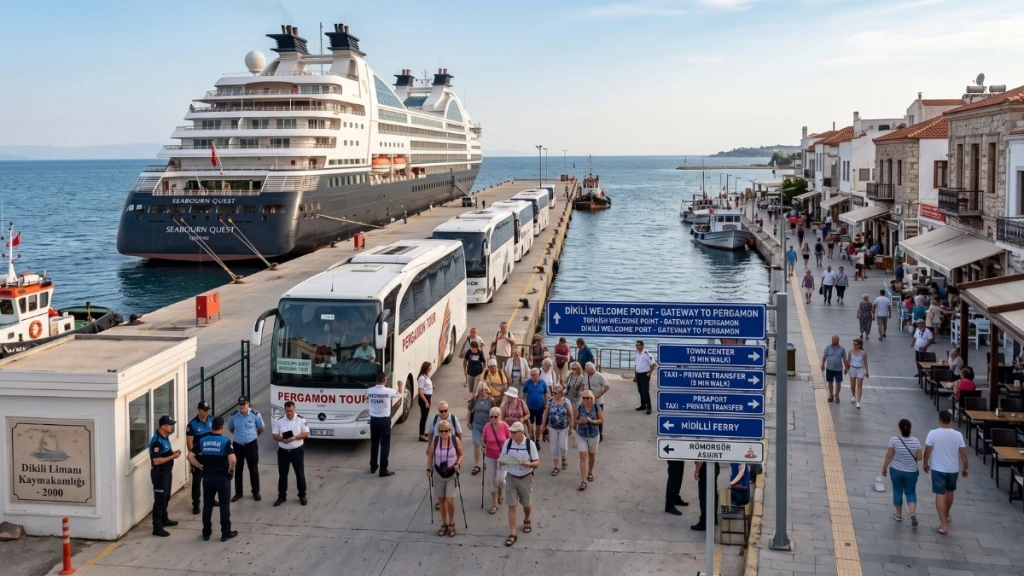
The GoTürkiye page of the Turkish Tourism Promotion and Development Agency states that Bergama Ancient City can be reached from Dikili Port with an approximately half-hour overland journey, that the port is about a 5-minute walk from the city center, and that a significant portion of cruise ships call at Dikili to visit Bergama. This makes Dikili a natural maritime gateway to Pergamon, similar to the relationship between Ephesus and Kuşadası.
2024: The Year Dikili Declined While Turkey Grew
According to the 2024 Statistical Bulletin of the General Directorate of Maritime Affairs of the Ministry of Transport and Infrastructure, 1,195 cruise ships called at Turkish ports throughout the year, carrying a total of 1,889,426 cruise passengers. Compared with the previous year, the increase in the number of ships was only 0.3%, while the increase in passenger numbers was 22.5%. This indicates that the Turkish cruise market grew in 2024 with a higher passenger volume.
Dikili, however, moved in the opposite direction from the nationwide growth that year. According to official data, 15 cruise ships called at Dikili Port in 2024, with 4,513 passengers recorded. In the same table, Kuşadası had 524 ships and 821,748 passengers, İzmir had 66 ships and 171,614 passengers, and Çeşme had 73 ships and 53,967 passengers. Although Dikili’s figures are smaller in volume, the segment of the arriving ships clearly demonstrates the port’s distinct position in the market.
Cruise Ships Calling at Dikili in 2024
The 2024 Dikili passenger ship schedules included vessels such as Seabourn Quest, Seven Seas Voyager, Star Clipper, Seabourn Encore, Oceania Riviera, Star Flyer, Celestyal Journey and Seven Seas Navigator. The presence of 15 calls on the schedule is also consistent with the Ministry’s official year-end total of 15 ships. The schedule source specifically notes that cruise calendars may change for operational reasons.
Ship / Brand | Segment | Approximate Passenger Capacity | Significance for Dikili |
Star Clipper / Star Flyer | Boutique sailing cruise | 166 | Strong fit for small ports and experience-focused itineraries |
Seabourn Quest | Ultra-luxury | 458 | Small-scale premium passenger profile with high spending potential |
Seabourn Encore | Ultra-luxury | 600 | Higher capacity but still in the boutique/luxury segment |
Example: Seven Seas Grandeur | Luxury | 744 | A next-generation ship representing Regent’s high-income passenger segment |
Star Clippers’ official technical information gives Star Flyer and Star Clipper a passenger capacity of 166, a length of 115.5 meters, a width of 15 meters, a draft of 5.8 meters and a tonnage of 2,298 GT. Seabourn Quest, meanwhile, is in the ultra-luxury segment with 458 passengers and a length of 650 feet (approximately 198 meters). This profile suggests that Dikili is naturally better positioned for boutique, premium and luxury itineraries rather than mega-ships.
2025: A Strong Recovery
2025 was much more positive for Dikili. According to Ministry of Transport and Infrastructure data, the number of cruise ships in Turkey as a whole rose to 1,375, while passenger numbers reached 2,138,136. Dikili Port reached 24 ships and 8,453 passengers. Thus, compared with 2024, the number of ships increased by 60% and the number of passengers by approximately 87%.
This increase shows that the decline in 2024 was not a permanent loss of market share. In small-scale destinations such as Dikili, the route decision of just a few cruise companies can significantly change the annual total. Therefore, instead of reading the figure for a single year as a long-term trend, periods of at least three years and the repeat-call rates of ship brands should be evaluated together.
First 7 Months of 2026:
Increase Across İzmir, Sharp Decline in Dikili
During the January–July period of 2026, the total number of cruise passengers at the ports of İzmir, Çeşme and Dikili rose from 77,133 to 90,907. This represents a regional increase of approximately 17.9%. However, Dikili diverged from the other two ports during the same period.
While 13 ships and 3,104 passengers were recorded in Dikili during the first seven months of 2025, the number of ships fell to 10 and total passenger numbers declined to 1,643 during the same period in 2026. Thus, the decline in passenger numbers was 47.1%. Transit passenger numbers also fell from 2,967 to 1,499. In contrast, the number of ships at İzmir Alsancak rose from 28 to 35, while the number at Çeşme increased from 37 to 39. Therefore, the table for the first seven months of 2026 should be read as “İzmir is growing in cruising, but Dikili is unable to share the same growth.”
Period | Cruise Ships | Cruise Passengers | Note |
2024 year-end | 15 | 4,513 | Dikili remained weak while Turkey grew |
2025 year-end | 24 | 8,453 | Strong recovery |
January–July 2025 | 13 | 3,104 | Comparison period |
January–July 2026 | 10 | 1,643 | 47.1% decline in passengers |
Note: The 2026 data is not a year-end result. Since the cruise season continues in late summer and autumn, a definitive annual assessment should not be made before the year is complete.
Technical Features and Physical Structure of Dikili Port
Publicly available sources provide different technical measurements for Dikili Port. GoTürkiye reports that the main pier is 132 meters long and 15 meters wide, that the total berthing line is 252 meters, and that there are three berthing positions. The Dikili District Governor’s Office states that the port was completed in 2000 with a length of 132 meters and a depth of 8.5 meters, and that it also serves regional cargo transportation.
With such technical values, it is possible that different sources refer to different periods or different sections of the quay. Therefore, in an actual cruise operation, ship acceptance should be planned according to the current LOA, draft, weather and sea conditions, maneuvering area, mooring arrangements, pilotage and approvals from the port authority. General information on websites does not replace operational suitability approval.
Why Does Dikili Not Have to Become a Mega Cruise Port?
Success in cruise tourism does not solely mean berthing the largest ship. Kuşadası and İstanbul can establish a high-volume model with large ships carrying thousands of passengers. Dikili’s competitive advantage is different: a small-town urban fabric, quick access by land, its UNESCO Bergama connection and the feel of a destination suited to boutique ships.
In the 2024 data, the average number of passengers per ship was approximately 301, while in 2025 it was approximately 352. These figures show that Dikili operates with smaller-capacity ships rather than mass tourism. When managed correctly, this can be a high-value niche rather than a disadvantage.
How Does Cruise Operations Work in Dikili?
A cruise ship call is a multi-stakeholder process that begins long before passengers disembark. Coordination is required among the ship’s agent, port operator, Port Authority, pilotage, security, customs and passport units, and the tour agencies conducting the shore operation.
- Confirming the ship’s schedule, ETA/ETD, technical specifications, draft and mooring plan
- Planning pilotage, tugboats or other port services
- Preparing customs, border and security procedures
- Managing passenger disembarkation and terminal/pier flows
- Positioning tour buses, guides, private transfer vehicles and agency teams on site
- Distributing passengers among Bergama, Asklepion, Dikili center or alternative coastal programs
- Checking tour return times against the ship’s “all aboard” time
- Preparing a crisis plan for unexpected situations such as delays, medical issues, missing passengers, transportation problems or weather conditions
If berthing is not possible for large ships, a tender operation may be considered. In such a scenario, the ship anchors offshore and passengers are brought ashore using the ship’s tender boats or suitable service vessels. This operation is highly dependent on weather, sea conditions, pier capacity and safety criteria.
Bergama: The Main Engine of Dikili’s Cruise Product
Dikili’s strongest sales argument in the international cruise market is Bergama. UNESCO included the “Pergamon and its Multi-Layered Cultural Landscape” site on the World Heritage List in 2014. The site contains the Hellenistic Attalid capital, the Roman-era Asklepion, and Byzantine and Ottoman layers within the same cultural landscape.
For this reason, it is meaningful that the destination is sometimes marketed as “Dikili (Pergamon)” in cruise programs. For passengers, Dikili is the port gateway, while Bergama is the main cultural attraction. When this connection is packaged properly, Dikili offers access by a very short land transfer to a world-renowned archaeological destination on Aegean cruise itineraries.
However, Economic Value Should Not Be Limited to Sending Buses to Bergama
Dikili’s fundamental problem is that if passengers disembark, board buses from the port to Bergama, and are taken directly back to the ship upon return, the district economy receives only a limited share. The fact that the port is only a few minutes’ walk from the town center is actually a significant advantage.
A controlled 45–90-minute Dikili segment could be added before or after the Bergama tour: a seaside walk, local olive oil tasting, a small-producer market, Aegean herbs, a café or restaurant break, local handicrafts and photo spots. The aim is not merely to get passengers off the ship, but to ensure that they spend money ashore and form a connection with the destination.
Why Are Boutique and Luxury Cruises Valuable for Dikili?
CLIA’s 2024 global economic impact report, prepared with Oxford Economics, states that the cruise sector generated 198.8 billion dollars in global economic output in 2024, supported 1.8 million jobs and saw passenger spending rise by 23% compared with the previous year. These figures show that cruise tourism is also important for the local economy beyond the port.
For Dikili, the critical point here is not the number of passengers but their profile. Products such as Seabourn, Regent or Star Clippers may bring fewer guests, but these guests can have a high potential for spending on experiences, gastronomy, private tours and culture. Therefore, Dikili’s strategy could be based not on “the most ships,” but on “the right ship + the right tour + high local spending.”
Shore Excursion Products That Could Be Developed in Dikili
Tour Product | Positioning |
Pergamon & Asklepion | The classic main product, with a professional guide, early-entry planning and strong time management. |
Pergamon + Dikili Seafront | A model that completes the main cultural tour with a short gastronomy and shopping break in the town center. |
Bademli & Northern Aegean Coast | A boutique experience focused on small groups, photography, coastal scenery and local flavors. |
Nebiler / Aşıklar Waterfall | An alternative product for passengers seeking nature and a short hike. |
Olive Oil & Aegean Gastronomy | Tastings, producer visits and a local table experience for small groups from premium ships. |
Private Pergamon | Private vehicle for 2–6 people, personal guide, flexible breaks and upper-segment service. |
How Is the Dikili–Lesbos Route Changing the Port’s Role?
Dikili Port should no longer be considered solely from a cargo and cruise perspective. The restoration of the Dikili–Lesbos fast ferry connection is also making the port part of regular international passenger traffic. Cruise and ferry passengers are different markets and are recorded in separate statistics; however, they benefit from the same customs, border, transportation, urban wayfinding and destination infrastructure.
In the long term, this creates a threefold port identity for Dikili: a commercial cargo port, an international ferry gateway and a boutique cruise destination. Urban planning, directional signage, transfer areas, taxi organization, tourist information, multilingual content and digital destination services can be developed by considering these three functions together.
Recommended Cruise Strategy for Dikili
- Strengthen the message “Dikili – Gateway to Pergamon” in international promotion.
- Instead of entering the mega-ship race, focus on the boutique, luxury, sailing cruise and yacht-cruise segments.
- Conduct direct destination marketing with cruise line itinerary planners and shore excursion teams.
- Include Dikili town center in the economic chain of Bergama tours in a controlled manner.
- Establish a multilingual cruise welcome point, map, QR guide, taxi/private transfer and tour information system at the port exit.
- Design products according to the ship: do not apply the same operation to a 166-passenger Star Clipper and a luxury ship carrying more than 700 passengers.
- Prepare local businesses for cruise days: foreign languages, visible pricing, card payments, tax-free eligibility and fast service.
- Measure performance not only by the number of ships, but also by the rate of passengers going ashore, excursion sales rate, local spending per person and number of repeat calls.
Conclusion:
Dikili’s Problem Is Not a Lack of Potential, but Turning Potential into Economic Value
Fifteen ships and 4,513 passengers in 2024, 24 ships and 8,453 passengers in 2025, and 10 ships and 1,643 passengers in the first seven months of 2026... The figures clearly show that Dikili’s cruise market is volatile. At the same time, however, the rapid recovery in 2025 proves how quickly the port can grow with the right route decisions.
Dikili does not have to aim to imitate Kuşadası’s model of hundreds of thousands of passengers. A more realistic and more valuable model is to create a boutique cruise gateway that brings together UNESCO Bergama, the Northern Aegean coast, local gastronomy and the small-scale, high-quality ship segment.
The true measure of success for Dikili should not be “how many ships arrived?” but “how much tourism value did the arriving ships leave in the district?”
Sources
1. Ministry of Transport and Infrastructure, General Directorate of Maritime Affairs – Maritime Trade Statistics, 2024 – https://denizcilik.uab.gov.tr/uploads/pages/yayinlar/denizcilik-istatistik-bulteni-2024.pdf
2. Ministry of Transport and Infrastructure, General Directorate of Maritime Affairs – Maritime Trade Statistics, 2025 – https://denizcilik.uab.gov.tr/uploads/pages/yayinlar/istatistik-bulteni-2025-02-02-2026.pdf
3. DHA – İzmir ports hosted 90,907 cruise passengers in the first 7 months, 31.08.2026 – https://www.dha.com.tr/yerel-haberler/izmir/izmir-limanlari-ilk-7-ayda-90-bin-907-kruvaziye-2936482
4. Egedesonsöz – Cruise traffic accelerates in İzmir! (2025–2026 January–July port-based passenger data) – https://www.egedesonsoz.com/izmirde-kruvaziyer-trafigi-hizlandi
5. GoTürkiye – İzmir / Dikili Port – https://goturkiye.com/tr/cruising/izmir-dikili-limani
6. Dikili District Governor’s Office – General information about Dikili and port infrastructure – https://www.dikili.gov.tr/dikili-ataturk-meydani
7. UNESCO World Heritage Centre – Pergamon and its Multi-Layered Cultural Landscape – https://whc.unesco.org/en/list/1457/
8. Cruise Lines International Association (CLIA) – Contribution of Cruise Tourism to the Global Economy 2024 – https://cruising.org/resources/contribution-cruise-tourism-global-economy-2024
9. Star Clippers – Technical specifications of Star Flyer / Star Clipper – https://www.starclippers.com/en/our-fleet/star-flyer.html
10. Seabourn – Seabourn Quest ship information – https://www.seabourn.com/en/us/cruise-ships/seabourn-quest/4
11. Regent Seven Seas Cruises – Seven Seas Grandeur ship information – https://www.rssc.com/cruises/GRA260517/summary
12. Su Üstünde – 2024 Dikili Passenger Ship Schedule – https://www.suustunde.com/tr/content-details/2024-dikili-yolcu-gemi-programi.html?ContentID=979
Editorial note: The 2026 data covers the January–July period and is not a year-end result. Cruise schedules may change due to weather, operations, company itinerary changes and port conditions. Final technical decisions regarding the port’s ship acceptance capacity should be made according to current data from the port and official maritime authorities.