Vatousa Village: A Historical Treasure Preserved in the Stone Streets of Lesvos
Are you ready to step away from the crowded beaches of Lesvos Island, get lost among centuries-old stone houses, and discover the forgotten stories of the Aegean?
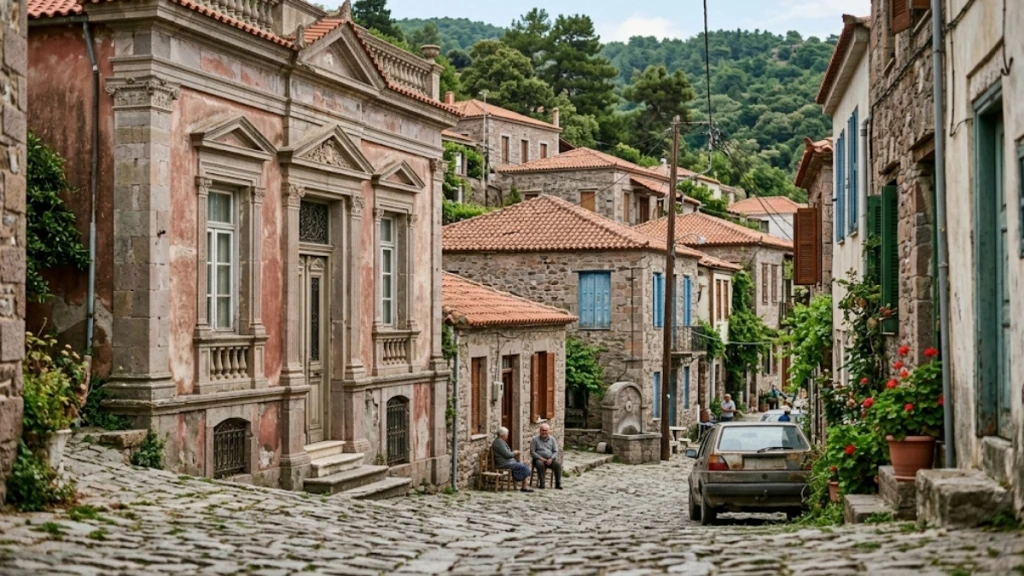
In the northwest of Lesvos, hidden among lush green hills, lies a village. Its narrow stone streets, red-tiled houses, grand mansions and churches nearly two centuries old transport visitors to a completely different time.
This place is Vatousa (Βατούσα).
At first glance it may appear to be a quiet Greek village. Yet behind these stone walls lie surprising stories reaching back to Istanbul, Izmir, the Ottoman period, and even millions of years into the past.
Vatousa is not only a beautiful village worth seeing; for those who want to understand the history of Lesvos, it is almost an open-air museum.
Where Is Vatousa Village? A Journey to Lesvos's Hidden Paradise
Vatousa is located in the northwest of the Greek island of Lesvos, approximately 67 kilometers from the city of Mytilene, at an altitude of 300 meters.
This historic settlement, near the villages of Antissa, Skalochori and Pterounda, is surrounded by green hills and ancient volcanic terrain.
As you approach Vatousa, the landscape gradually begins to change. Coastal towns give way to wooded slopes, old stone houses and narrow village roads.
Once you enter the village, the first thing that catches your attention is the silence itself.
On one side are colorful houses with wooden shutters, on the other stone walls that have stood for centuries... Some streets open onto small squares, while others suddenly reveal a magnificent mansion.
The beauty of Vatousa lies in not wanting to be rushed through.
The History of Vatousa: An Aegean Story Spanning More Than 600 Years
The past of Vatousa reaches back at least to the 15th century, the Late Byzantine period.
According to the research of local historian Yannis Manoukas, the village initially consisted of small settlements sustained by agriculture and animal husbandry.
With the incorporation of Lesvos into the Ottoman administration in 1462, Vatousa, like the other settlements of the island, entered a new historical period.
Small villages and neighborhoods that were initially scattered in the surroundings gradually merged around what is today Vatousa.
However, Vatousa's real transformation took place in the 18th and 19th centuries.
The Wealth That Flowed from Istanbul and Izmir to Vatousa
One of the most surprising stories of Vatousa is hidden in its economic and cultural connections with the great cities of the Ottoman world.
- In the 18th and 19th centuries, many Vatousans migrated to Istanbul, Izmir and various regions of the Ottoman Empire to trade or work. Some even reached as far as Central Europe.
These people, establishing lives in new cities, sent a portion of their earnings back to the village where they were born.
The money sent did not only change the lives of families.
New houses were built. Impressive mansions rose. Educational institutions developed. The village's architecture gradually acquired a more urban identity.
Some of the large stone mansions we see on the streets of Vatousa today are the legacy of this economic prosperity.
The traces of wealth earned in Izmir and Istanbul continue to live on in the walls of a small mountain village on Lesvos.
In this sense, Vatousa reminds us that the Aegean Sea was once not merely a boundary separating two shores, but also a crossing area connecting people, cultures and trade.
The Stone Houses of Vatousa: One of Lesvos's Most Impressive Village Architectures
Walking through the streets of Vatousa, you may feel as though you are inside a historical film set.
The foundation of the village architecture consists of stones quarried locally, red-tiled roofs, wooden doors and colorful window shutters.
However, there is an important feature that distinguishes Vatousa from other traditional Lesvos villages: the coexistence of traditional Aegean village architecture and neoclassical mansion architecture.
Right beside modest stone houses rise magnificent mansions distinguished by large windows, symmetrical facades and ornate entrances.
This architectural richness is no coincidence. It is a visible result of the 19th century, when the village prospered economically.
The organic structure of the narrow streets, the stone paving, the small courtyards and the way the buildings adapt to the sloping terrain preserve the old settlement character of the village.
Vatousa's historic fabric is so valuable that the village was included among the traditional settlements placed under protection in Greece in 1978.
Walking through the village today means not only seeing old buildings, but also following the traces of a settlement culture centuries old.
Places to Visit in Vatousa: 5 Important Stops Along the Trail of History
Vatousa may be a small village, but it is extremely rich in historic structures, architecture and cultural heritage.
Here are the places we especially recommend seeing on your visit to Vatousa:
1. Taksiarhis Church: From the 1830s to the Present
One of the village's most striking historic buildings is the Taksiarhis Church (Church of the Taxiarches), dedicated to the Archangels Michael and Gabriel.
According to the official tourism sources of Lesvos, the church was built in 1832–1833.
The building is an impressive example of domeless basilica architecture, also seen on the eastern Aegean and Anatolian coasts.
Around the church, known for its thick stone walls, arched architectural elements and historic character, there is a quite interesting cemetery.
Some of the graves here differ from typical grave structures, being built of stone and covered with vaulted tops.
These unusual graves make the church important not only from a religious perspective but also in terms of local funerary architecture.
Standing in front of Taksiarhis Church, you may feel that you are at the threshold of the religious and social life of 19th-century Lesvos.
2. Gogos Mansion: From a Family's Story to the Memory of the Village
One of the most magnificent structures in Vatousa, the Gogos Mansion (Archontiko Gogou) is one of the finest examples of the village's architectural richness.
Completed in 1890, this neoclassical mansion was commissioned by Doctor Georgios Gogos to be given to his daughter as a dowry.
With its wide windows, ornate stone details, balanced facade arrangement and striking architecture, it stands apart from traditional village houses.
However, the story of the mansion is not limited to its architecture alone.
The building was donated to the village community at the end of the 1960s. It was restored in the 1980s and reopened as a cultural center in 1989.
Today it houses the Vatousa Folklore Museum.
The museum contains traditional costumes, old agricultural tools, household items, photographs and collections of historic books.
For understanding the village's past, the Gogos Mansion is one of the most valuable stops on a visit to Vatousa.
3. Church of the Dormition of the Theotokos: A Faith Heritage Carved in Stone
Built in 1850, the Church of the Dormition of the Theotokos (Koimisi tis Theotokou) is Vatousa's other important religious building.
Made entirely of finely worked stone, the church stands out for its architectural details.
In particular, its carved wooden iconostasis is considered a fine example of the traditional Orthodox art of the Aegean.
The churchyard also has a small museum displaying works related to Byzantine art and church history.
4. Historic Schools: The Great Educational Story of a Small Village
Perhaps one of the least known yet most impressive aspects of Vatousa's history is education.
According to local archival records, the village's first modern school opened in 1841.
In 1864, construction began on a new school building.
In 1871, Vatousans living in Istanbul established an education association to support education in the village.
Imagine...
Already in the 19th century, the people of a mountain village on Lesvos were organizing in Istanbul to contribute to the education of children in their birthplace.
The old Boys' School and Girls' School buildings of the village are important surviving witnesses to this cultural heritage.
The story of Vatousa shows us that the wealth of a village can be measured not only by its grand houses but also by the value it places on education.
5. Historic Streets, Fountains and Village Life
Perhaps the most pleasant activity in Vatousa is walking its streets without rushing to any particular place.
Discover the old stone fountains.
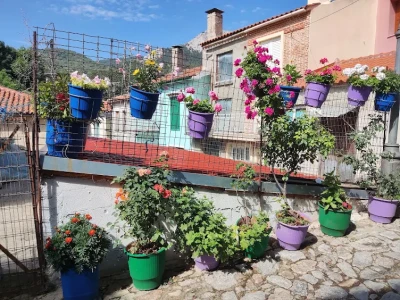
Photograph the colorful-shuttered houses.
Notice the small architectural details hidden along the narrow streets.
Pause in the village square and savor the atmosphere of traditional settlement life.
Sometimes the most beautiful travel memories are hidden not in great monuments, but in an unexpected corner of a village street.
A Village Founded Inside an 18-Million-Year-Old Volcano!
The story of Vatousa is not limited to human history alone.
The geography where the village sits was shaped by volcanic activity around 18 million years ago.
According to information provided by the Lesvos Geopark, Vatousa was established within an ancient volcanic caldera about 6 kilometers in diameter.
The hills, rocky areas and natural landscape surrounding us today carry the traces of this distant geological past.
Around the village there are oak forests, stands of black pine and plants such as yellow rhododendron.
With these features, Vatousa is an intriguing place of discovery not only for travelers interested in history and architecture, but also for nature lovers.
On one side a geological past millions of years old, on the other stone structures hundreds of years old...
In Vatousa, the time of nature and the history of humanity meet in the same landscape.
Where Does the Name Vatousa Come From?
The village's name is as interesting as its history.
According to the most widely accepted explanation, the name Vatousa is connected to the Greek word Vatoessa, referring to areas abundant in thorny shrubs, especially bramble-like plants.
This explanation fits well with the village's green surroundings and natural vegetation.
Local narratives also relate a tradition that the icon of the village's protective Virgin Mary was found among the bushes.
In this way, the name Vatousa becomes more than a geographic label and forms part of the village's cultural memory.
When Should You Visit Vatousa Village?
Vatousa has a changing beauty across the different seasons of the year.
In spring, its greening nature, colorful plants and pleasant walking weather stand out.
In summer, it offers a good alternative for those who want to escape the coastal towns and explore the interior of Lesvos.
In autumn, the village's stone architecture, calm atmosphere and surrounding natural colors offer striking scenes for photography enthusiasts.
To explore Vatousa at an unhurried pace, setting aside about 2–3 hours for the village center is a good start. Museum visits and meal breaks can extend this time.
Since some sections of the historic streets are sloped and stone-paved, it is worth choosing comfortable walking shoes.
How Can You Add a Vatousa Visit to a Lesvos Tour?
Vatousa is a worthwhile stop for travelers who want to explore the western and northwestern regions of Lesvos.
It can be included especially in a travel plan covering the Antissa and Sigri area.
In this way, a single journey allows you to experience both traditional village architecture and the natural areas linked to Lesvos's volcanic past.
If you are planning to travel from Turkey to Lesvos, you can review the Lesvos Island tours offered by GÜVENTUR.
For those who want to explore the different regions of the island more comfortably, overnight Lesvos tours are also an alternative.
For a Vatousa visit, be sure to check the route of the program you choose. The village is not included in every standard Lesvos tour and may require special travel planning.
Frequently Asked Questions About Vatousa
Where is Vatousa Village?
Vatousa is a historic village in the northwest of the Greek island of Lesvos, approximately 67 kilometers from the city of Mytilene.
Why is Vatousa famous?
It is known for its traditional stone houses, neoclassical mansions from the 19th century, historic churches, preserved street fabric and impressive volcanic geography.
Does Vatousa Village date from the Ottoman period?
The village's past reaches back at least to the 15th century. A significant part of its current architectural identity took shape during the 18th and 19th centuries, when Lesvos was under Ottoman rule.
What historic churches are there in Vatousa?
The most important are Taksiarhis Church, dating to 1832–1833, and the Church of the Dormition of the Theotokos, built in 1850.
How much time should I spend in Vatousa?
About 2–3 hours can be set aside to explore the village center. A longer program is suitable for those who want to study the historic buildings in more detail or visit neighboring villages.
How do I get to Vatousa?
After reaching Lesvos by ferry, you can travel to the village within the island by rental car or a suitable private transfer. Transportation options should be planned in advance according to travel dates and departure point.
For Those Who Want to Discover the True Spirit of Lesvos: Vatousa
When Lesvos is mentioned, people usually think of the sea, beaches, ouzo tables and the stone streets of Molyvos.
Yet in the interior of this large Aegean island, far different stories are hidden.
Vatousa is one of the most striking of these.
Its connection to Istanbul and Izmir, its 19th-century grand mansions, its centuries-old schools, its historic churches and its millions-of-years-old volcanic landscape show how much a small village can tell.
Some places impress with their scenery, others with their history. Vatousa offers both.
If you want to step off Lesvos's usual tourist routes, search for traces of the past in old stone streets and get to know Aegean culture more closely, add Vatousa to your list of discoveries.
Because some of Lesvos's true treasures are hidden not on the seashore, but among its mountains.
Discover Lesvos with GÜVENTUR
How about exploring Lesvos's historic villages, natural beauty and cultural heritage?
As GÜVENTUR Travel Agency, we are with you for ferry tickets, hotel reservations, car rental and Lesvos tour arrangements.
Explore Lesvos Tours
View Lesvos Ferry and Gate Visa Options
GÜVENTUR Travel Agency – TÜRSAB A-18232
Phone: +90 232 700 1 700
Sources and further reading: Visit Lesvos – Vatousa, Lesvos Geopark, Vatousa Local History Archive, History of Education in Vatousa.